Skip to content
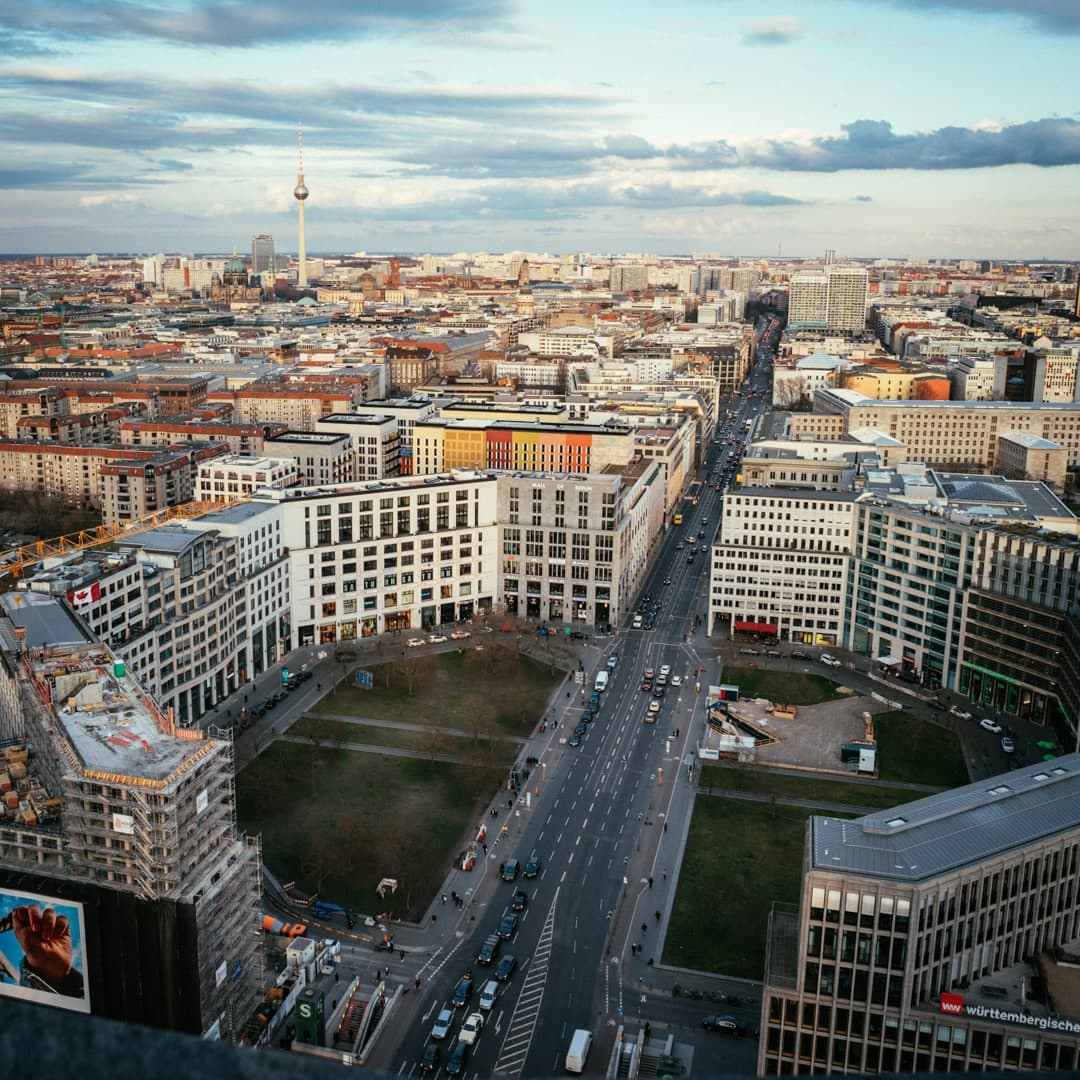
View east from the Panoramapunkt in Berlin’s Kollhoff Tower over Leipziger Platz and Leipziger Straße to the TV Tower

Berlin Experiences/Featured Experiences

Fastest Elevator in Europe: Ride Up to Berlin’s Panoramapunkt

An impressive twenty four floors in only 20 seconds.

The short answer

The Panoramapunkt is the viewing platform on the 24th and 25th floors of the Kollhoff Tower at Potsdamer Platz 1, and the lift that takes you up is billed as the fastest in Europe: about 90 metres in 20 seconds. It is open daily from 10:00, until 18:00 in winter and 19:00 in summer, and a standard ticket costs €9; you can buy it on the spot. S+U Potsdamer Platz is right outside the door. Allow 45 minutes to an hour for the view, the open-air exhibition and a coffee in the café.

Where
Kollhoff Tower, Potsdamer Platz 1, 10785 Berlin-Tiergarten
Open
Daily 10:00–18:00 in winter, 10:00–19:00 in summer; last lift 30 min before closing
Admission
€9; reduced €7; under-6s free; family €19.50
Time needed
45–60 minutes
Nearest station
S+U Potsdamer Platz, 2 minutes on foot
Step-free
Yes to the 24th-floor platform, by lift (max. 3 wheelchair users at once)

The story · by Matt Robinson

The Kollhoff Tower undoubtedly stands as one of the most elegant buildings of the modern Potsdamer Platz ensemble – reminiscent as it is of the iconic ‘Flatiron’ building in Manhattan, New York. Unlike its American cousin, however, this relatively recent addition to the city is three storeys higher – and capped with a two floor observation deck, known as the Panorama Punkt, offering a commanding 360° view over Berlin. More impressive than its distinctive shape and ornate red brick composition is that the Kollhoff Tower is also unique in regards to one other extravagance – as home to the fastest elevator in Europe.

This Thyssen passenger lift shuttles visitors up 24 floors in an impressive 20 seconds, travelling at a peak velocity of 31km/h to reach the viewing platform 90m up inside the building.

Far less popular – read: quieter – than the TV Tower, which dominates Berlin’s skyline from its position at Alexanderplatz, the Panorama Punkt is one of the city’s hidden gems. Not only a viewing platform but also a relaxing cafe, facing West and perfectly positioned to watch the sunset in the winter months.

Potsdamer Platz, then and now

Once one of Europe’s busiest junctions, a fact that made it ripe for the introduction of Germany’s first traffic light in 1924, Potsdamer Platz was pummeled into ruin during the Second World War. The Times Square or Piccadilly Circus of Berlin, as it had once been, was then left as a desolate wasteland during the Cold War period due to its position as the important intersection and confluence of the British, Soviet and American sectors of the city.

Following German reunification in 1990, the area became the focus of much attention – as a vast expanse of territory in the centre of one of Europe’s most important cities opened up to investors and an audacious redevelopment project by the Berlin Senate. Dubbed the ‘building site of Europe’, Potsdamer Platz was divided into four sections – controlled by car-maker Daimler, Japanese electronics firm Sony, German retailer Beisheim, and the additional Park Kolonnaden area.
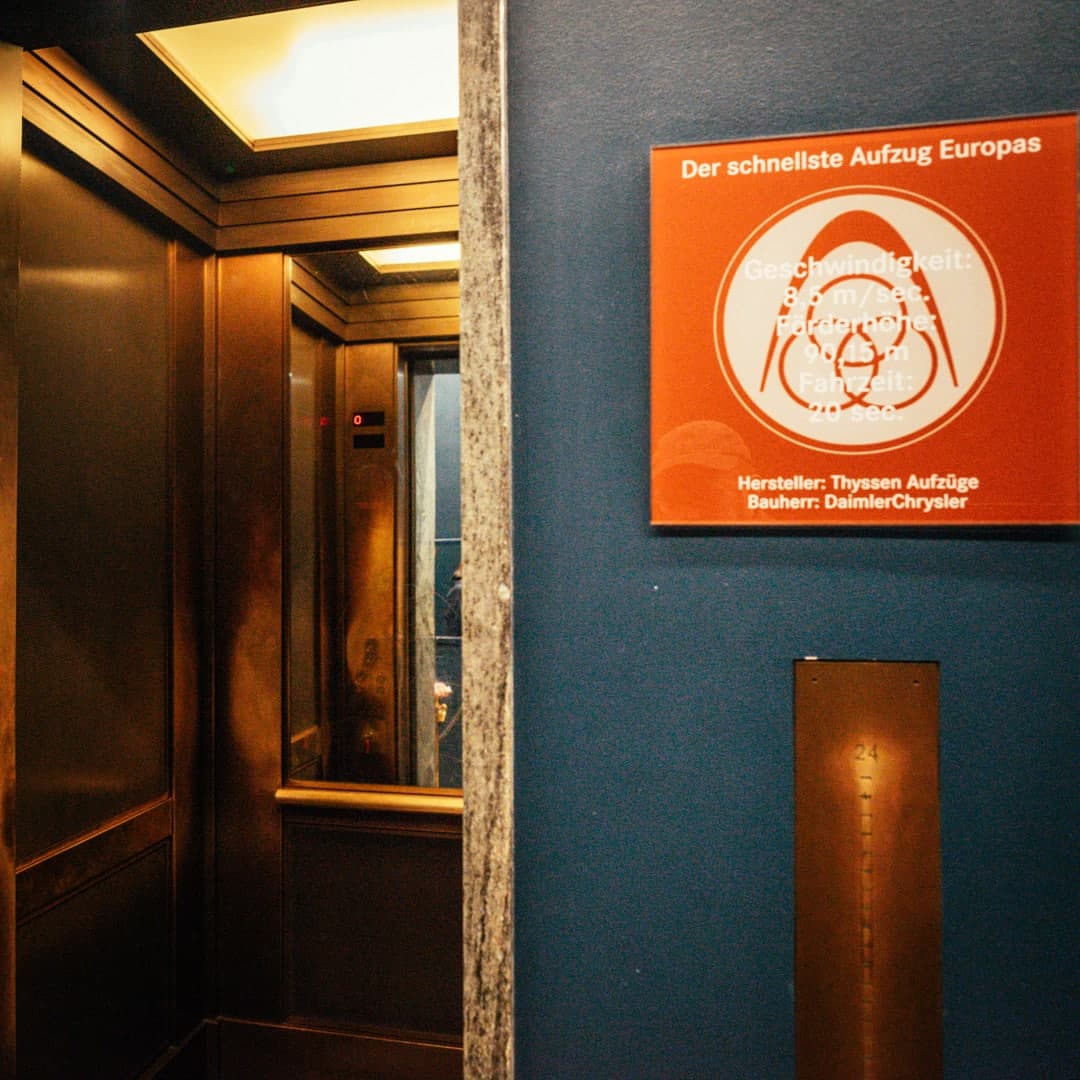
The wood-panelled car of Europe’s fastest lift in the Kollhoff Tower, doors open, with its record sign on the wall beside it
The lift car, with its ‘fastest in Europe’ sign beside the doors.

Since considered by many in the city as a failed attempt in urban planning, the area never managed to re-establish itself as the ‘beating heart’ of modern Berlin that it was in the 1920s. Despite its position almost directly between the former centres of the Cold War West (Zoo Station) and the Cold War East (Alexanderplatz), it has not become the unifying centre of the  post-reunification German capital. But instead a testament to the commercialisation, and so-called ‘Americanisation’, of modern Berlin. As beyond the initial 19 buildings proposed in the Senate plan, there is now a shopping arcade, series of cinemas, restaurants, hotels and, at the Theater am Potsdamer Platz, Cirque du Soleil’s first permanent show in Europe.

Oh, and the fastest elevator in Europe.

The view from the 25th floor

From the open air sun terrace on the 25th floor of the Kollhoff Tower at Potsdamer Platz it is possible to gaze down across this historic area and take in the surrounding buildings. Directly adjacent to the building, to the north, is the Berlin office of Deutsche Bahn, the national train provider, a 26-storey high glass ‘Bahn Tower’ rising up from next to the Potsdamer Platz train station.
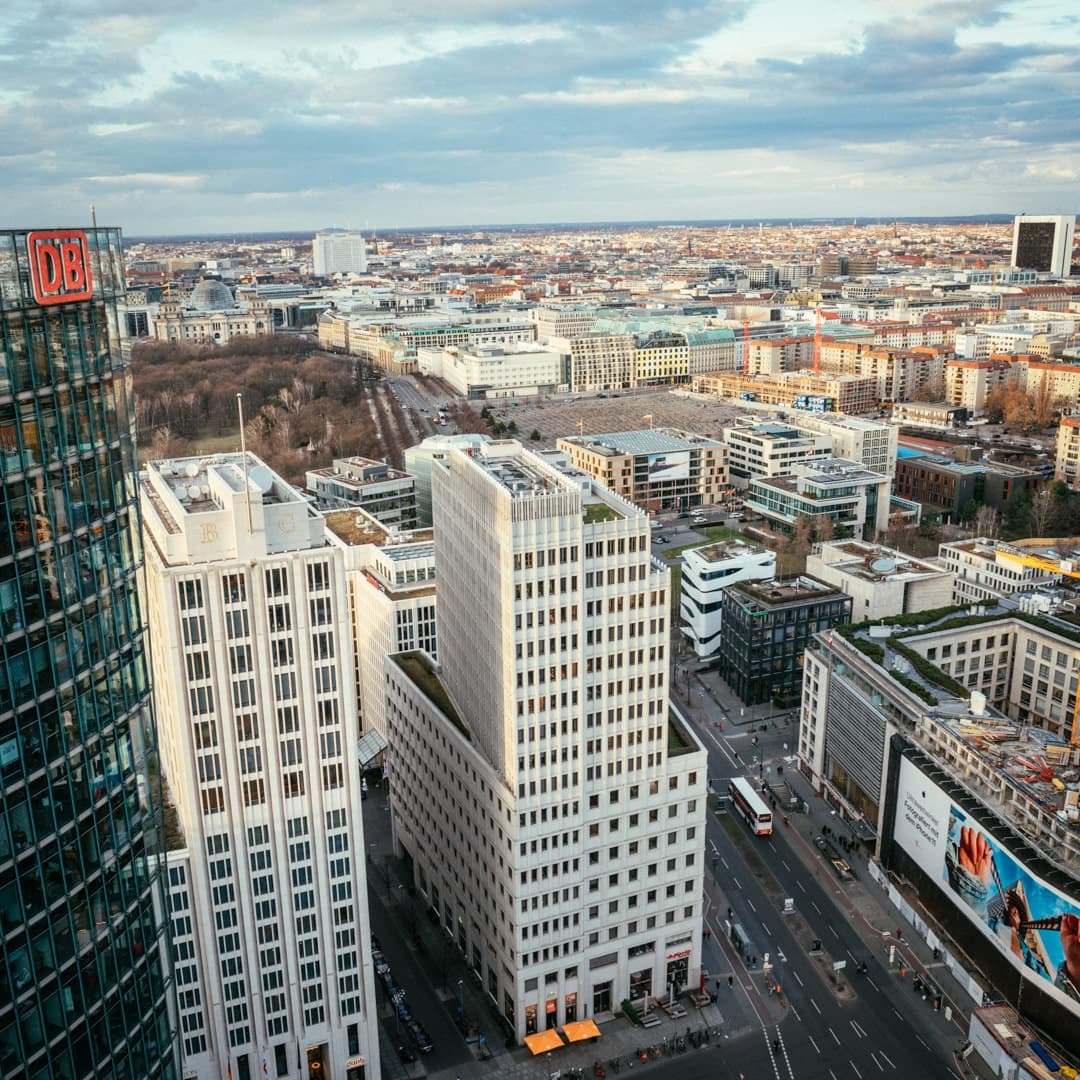
View north from the Panoramapunkt at Potsdamer Platz over the Beisheim Center towers to the Tiergarten, with the glass DB Tower on the left
Looking north, past the DB Tower towards the Tiergarten.

Seen from above, the distinctive peak of the Sony Centre to the north west is easily distinguishable – designed by German architect Helmut Jahn and featuring a conical roof that is said to have been inspired by the snow capped peak of Japan’s Mount Fuji. Beneath this tent-like structure is an open plaza of restaurants and stores, for years used as red-carpet ground zero for the Berlinale Film Festival held here every February. It is rumoured that one of the reasons for the Sony Centre being situated on the north-western side of the Potsdamer Platz plot is due to its position close to the Philharmonic building, and Sony executive Norio Ohga’s love of classical music. The Philharmonic building, with its easily recognisable yellow hue, is to the west of Potsdamer Platz in the Kulturforum ensemble.

Following the peak of the Kollhoff Tower pointing eastwards, it is possible to track the Berlin skyline across the horizon to see the city’s most important landmarks – from the Reichstag building, to the Brandenburg Gate, the concrete stelae of the Holocaust Memorial and the distant towers of Gendarmenmarkt. Although Berliners joke that the best view of the city is from inside the Fernsehturm, in that it is the only place you cannot see it, looking east from the Kollhoff Tower it is easy to see why it has become such an important symbol of the city – towering as it does so clearly above the skyline as the tallest structure in Germany.

The highest piece of the Wall

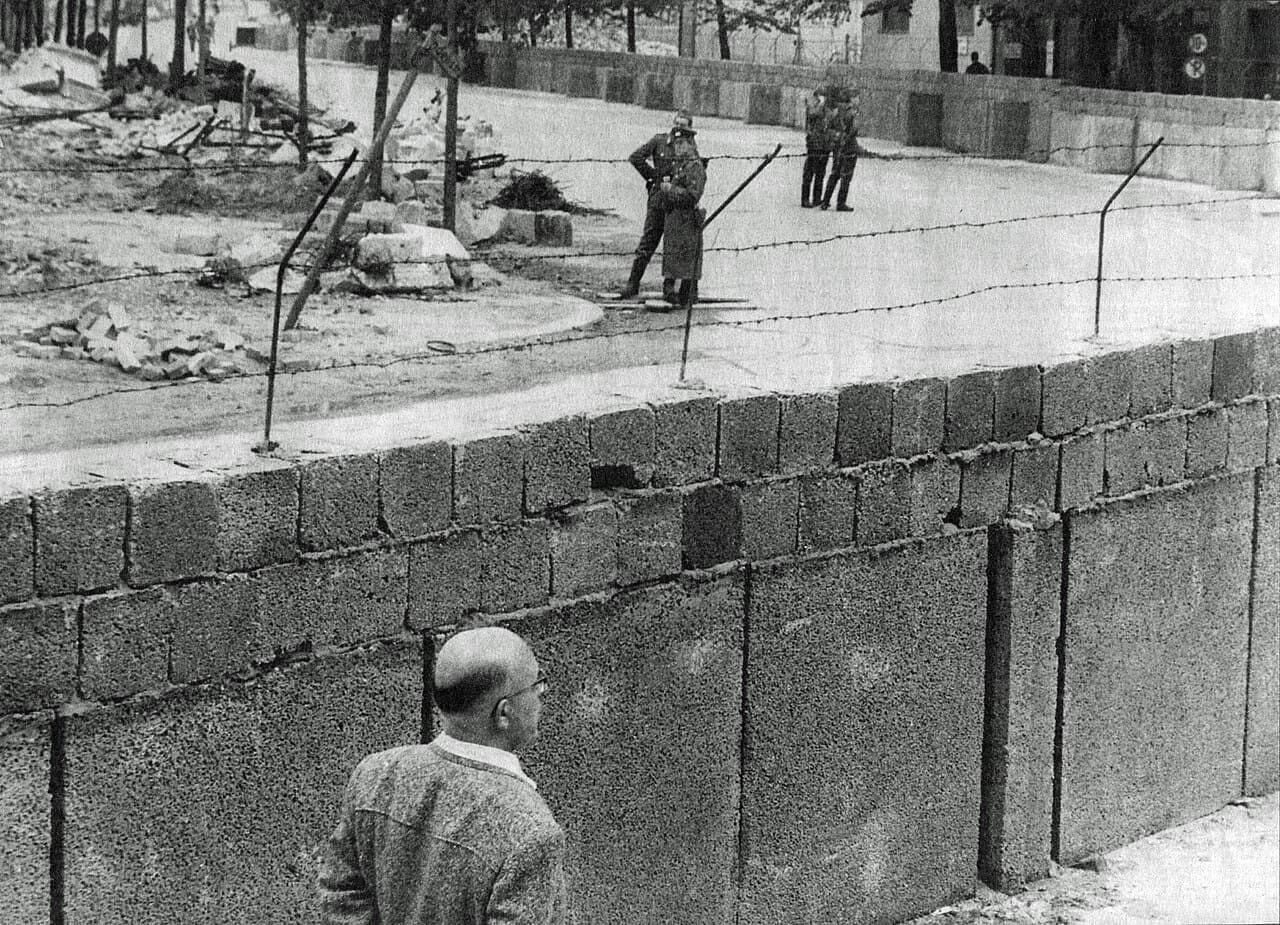
It is possible to look down to the street to the east of the building and spot the cobbled line tracing what was once the path of the Berlin Wall through the city – situated as the Kollhoff Tower is just west of the Cold War border. Some pieces of this infamous Wall remain visible – such as the section next to the Topography of Terror museum and Berlin parliament, on Niederkirchnerstraße to the south east of Potsdamer Platz.

However, one piece is much easier to find when visiting the Panorama Punkt, that is the section that now rests on the top level of the building – transported to its present position in 2010 by helicopter. The other unique detail that this building has to offer – the highest piece of the Berlin Wall anywhere in the world.
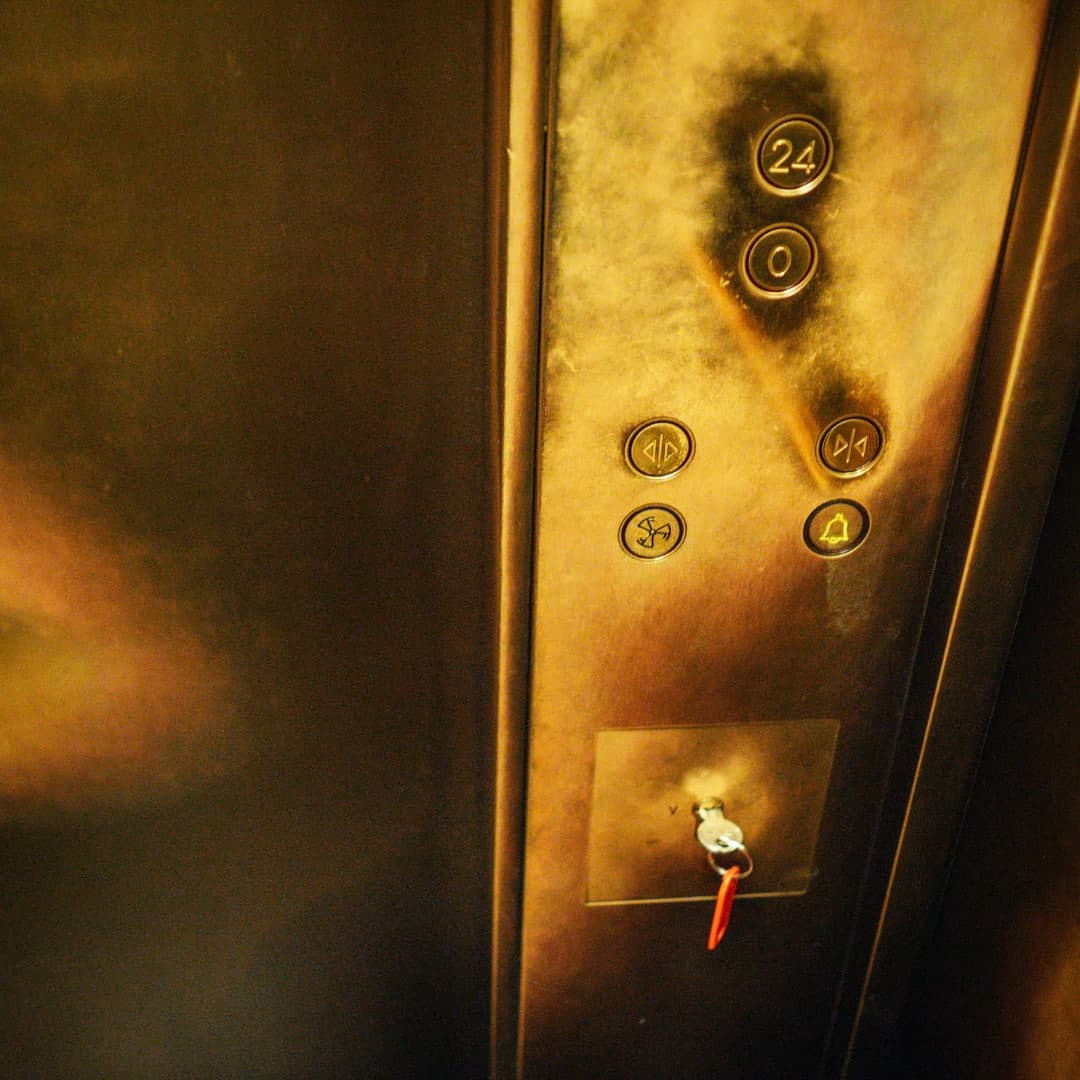
Brass buttons for floors 24 and 0 inside the Panoramapunkt lift in the Kollhoff Tower, Berlin
Two buttons: the 24th floor and the ground.

Returning to the ground floor using the elevator is just as quick as travelling to the top – and usually includes the same ear popping sensation that comes with flying. Regardless of how long you spend gazing across the horizon, relaxing in the PanoramaPunkt cafe, or reading the many info boards arranged around the open air terrace – you’ll likely find the experience more relaxing and equally if not more rewarding than brawling to enjoy the more prominent TV Tower. Which has much to offer in its own right – but cannot boast to have the fastest lift in Europe.
The Panoramapunkt in detail

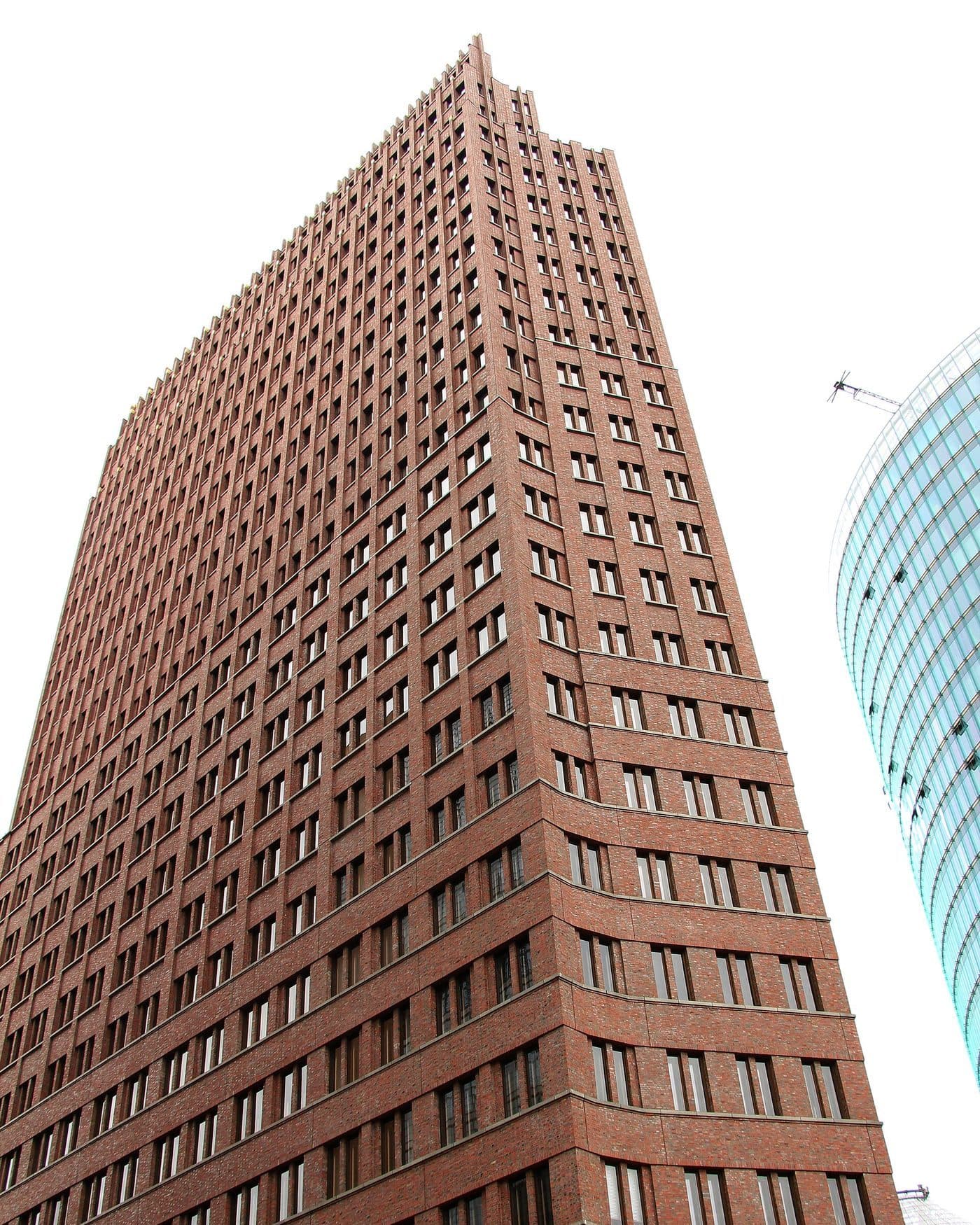
The red-brick Kollhoff Tower at Potsdamer Platz in Berlin, seen from below, with the glass DB Tower on the right
The Kollhoff Tower, finished in 1999. The Panoramapunkt is on the top two floors. Photo: Fred Romero / CC BY 2.0, via Wikimedia Commons

Is it still Europe’s fastest lift?

The sign beside the lift gives the official figures: built by Thyssen Aufzüge for DaimlerChrysler, it climbs 90.15 metres at up to 8.5 metres a second and takes 20 seconds. Other sources, among them the Berliner Zeitung’s report on the opening in April 2000, give 8.65 metres a second. Either way the car touches about 31 km/h, but it spends much of the short ride speeding up and slowing down, so the average is closer to 4.5 metres a second.

We checked the claim in November 2026 and found no faster passenger lift in Europe. The nearest rivals run at about 8 metres a second: the shuttle to the observation deck of the Lakhta Center in St Petersburg, Europe’s tallest building, and the double-deck lifts of 22 Bishopsgate in London. The fastest in the world are in Asia: Hitachi’s lift in the Guangzhou CTF Finance Centre was certified at 21 metres a second in 2019, well over twice the speed.

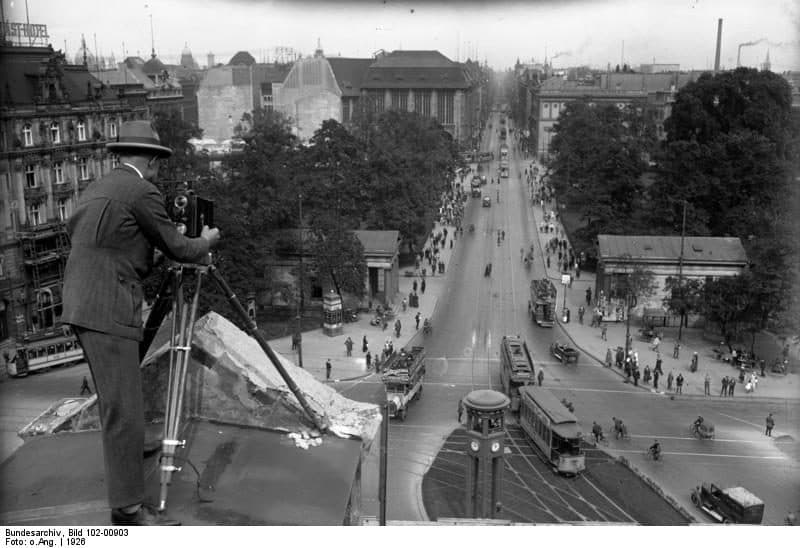
A cameraman filming Potsdamer Platz in 1926, with trams, the traffic light tower and Leipziger Straße below
Filming Potsdamer Platz in 1926. The traffic tower stands at the centre of the junction. Photo: Bundesarchiv, Bild 102-00903 / CC-BY-SA 3.0

Europe’s busiest square

In the 1920s Potsdamer Platz was the busiest traffic junction in Europe. In the summer of 1924 about 24,000 vehicles crossed it every day: trams, cars, motorbikes, horse-drawn carts and thousands of bicycles. To bring some order, the city put up a five-sided traffic tower, designed by Jean Krämer, which went into service on 15 December 1924. A policeman in the cabin at the top switched the coloured lights, and it is counted as Germany’s first traffic light.

Around the square stood the hotels, cafés and stations of a world city: the Potsdamer Bahnhof terminus, Café Josty and Haus Vaterland, a huge entertainment palace of themed restaurants. The tower came down in 1937 to make way for the S-Bahn tunnel. A full-size replica, paid for by Siemens and Daimler-Benz, has stood in front of the station entrance beside the Kollhoff Tower since 2000, its lights still changing.

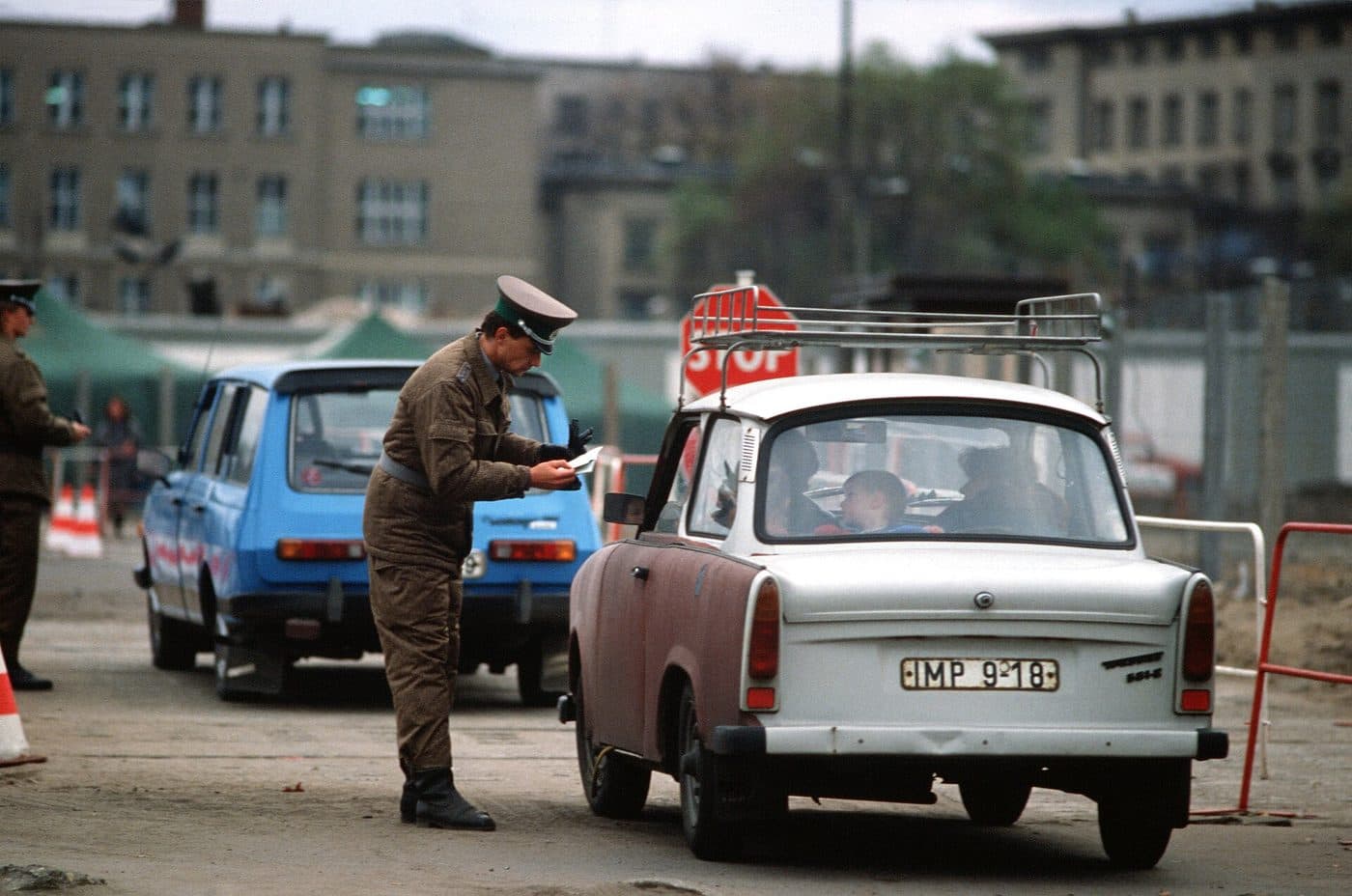
An East German border policeman checks a Trabant at the new opening in the Berlin Wall at Potsdamer Platz, November 1989
The new crossing at Potsdamer Platz, 14 November 1989. Photo: Staff Sergeant F. Lee Cockran, U.S. Department of Defense / Public domain, via Wikimedia Commons

From death strip to building site

After 1945 the ruined square lay where the British, American and Soviet sectors met, and it became a black market. From 13 August 1961 the Berlin Wall ran straight across it. The Kollhoff Tower stands on the western edge of the old border line; the land to the east became a wide, empty death strip, and visitors to West Berlin climbed a viewing platform to look over the Wall into the East.

On 12 November 1989, three days after the Wall opened, a new crossing was cut through it here. In July 1990 Roger Waters staged The Wall on the empty strip between Potsdamer Platz and the Brandenburg Gate. The land was sold to investors, Daimler-Benz and Sony among them, and for much of the 1990s Potsdamer Platz was the largest building site in Europe. The Kollhoff Tower was finished in 1999, and the Panoramapunkt opened on 15 April 2000.

Plan your visit

Visiting the Panoramapunkt

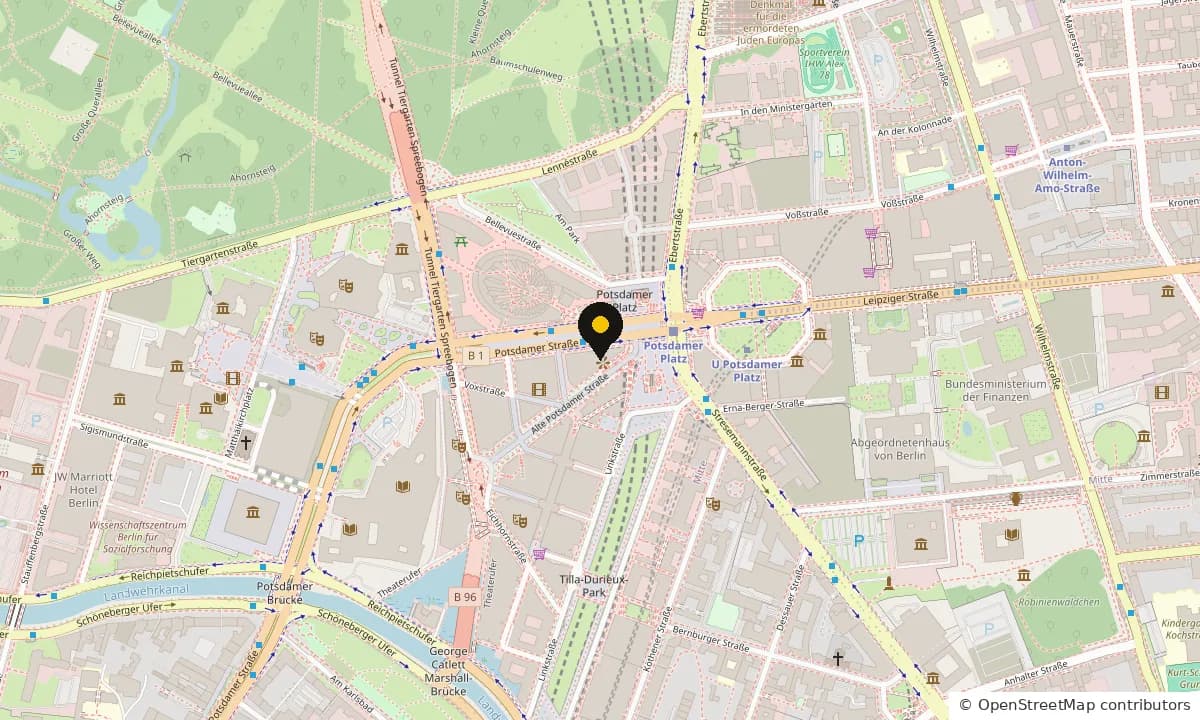
Map of the streets around the Panoramapunkt, with a pin on the siteOpen in Google Maps

Potsdamer Platz 1, 10785 Berlin · Daily. Viewing platform 10:00–18:00 in winter (last lift 17:30) and 10:00–19:00 in summer (last lift 18:30); Panoramacafé 11:00–17:00 in winter, 11:00–18:00 in summer. Hours can change on public holidays and for private events: call +49 30 25 93 70 80 if in doubt.

Getting there

  • S1S2S25S26Potsdamer Platz100 m · 2 min

    Regional trains (RE3, RE4, RE8, RE20, RB10) and the FEX airport express from BER stop here too. The entrance to the tower is on Potsdamer Straße, opposite the glass DB Tower.

  • U2Potsdamer Platz250 m · 3 min

    The U2 platform lies under the east side of the square, by Leipziger Platz: cross towards the brick tower at the tip of Alte Potsdamer Straße.

  • Bus 200Bus 300Bus M41Bus M48Bus M85S+U Potsdamer Platz Bhf150 m · 2 min

    Buses 200 and 300 run from Alexanderplatz along Unter den Linden; the 200 also comes from Zoologischer Garten.

What you’ll see

  • A 360° view from about 100 metres up: the Brandenburg Gate, the Reichstag dome, the Holocaust Memorial, the Tiergarten, the yellow Philharmonie and, to the east, the TV Tower above Leipziger Straße.
  • The open-air exhibition ‘Berliner Blicke auf den Potsdamer Platz’ around the 24th floor, which sets old photographs of the square beside the live view, and the piece of the Berlin Wall flown up by helicopter in 2010.
  • The sun deck on the 25th floor and the glazed Panoramacafé on the 24th, with coffee, cake and drinks; both are included in the ticket.

Tips from a guide

  • In winter, come for the sunset: the café and the platform face west across the Tiergarten, and in December the sun sets before 16:00, well before the last lift at 17:30.
  • The platform is open to the weather and windy even on calm days, so bring a layer. Binoculars can be hired for €2.50 (€30 deposit), and a 360° panorama map costs €3.
  • Look down to the east for the double row of cobbles that marks where the Wall ran, then follow it on foot afterwards to the Wall segments on Potsdamer Platz.

Accessibility

Wheelchair users are welcome on the 24th-floor viewing platform, which the lift reaches directly; for safety, no more than three wheelchair users may be on the platform at the same time. The operator does not say whether the 25th-floor sun deck can be reached without steps, so ask at the ticket desk. Reduced tickets (€7) are available for visitors with a disability of 50% or more and one companion. S+U Potsdamer Platz has lifts: check the BVG website for their status. Well-behaved dogs are allowed (small ones carried if necessary, larger ones muzzled).

Timeline

From traffic tower to viewing platform

  1. 15 Dec 1924Germany’s first traffic light tower goes into service on Potsdamer Platz.
  2. 1945Bombing and the battle for Berlin leave the square in ruins.
  3. 13 Aug 1961The Berlin Wall cuts across Potsdamer Platz.
  4. 12 Nov 1989A new crossing is opened in the Wall at Potsdamer Platz.
  5. 21 Jul 1990Roger Waters stages The Wall on the empty death strip nearby.
  6. 1995Building work on the Kollhoff Tower begins.
  7. 1999The 25-storey Kollhoff Tower is finished.
  8. 15 Apr 2000The Panoramapunkt opens on the top floors.
  9. 2009–10The platform closes while the brick façade is repaired; it reopens in June 2010.
  10. 15 Jul 2010A piece of the Berlin Wall is flown up to the 24th floor by helicopter.

See it with a historian

Tours that stop at the Panoramapunkt

From 100 metres up, a guide can show you where the Wall ran, what stood on the empty land in 1989 and why the new Potsdamer Platz looks the way it does.

Four hours on foot through the historic centre, with Potsdamer Platz and the line of the Wall on the way.

The Berlin Explorer Tour
Half Day4 Hours

The Berlin Explorer Tour

Private half-day walking tour of historic Mitte for up to 10 people. Starts at your hotel or anywhere in the centre.

€500up to 10
View Tour

One hour along the old border, which ran right past the Kollhoff Tower.

The Cold War Tour
One Hour1 Hour

The Cold War Berlin Tour

Private 1-hour walking tour of Cold War Berlin's border sites for up to 10 people. Starts by the Berlin Wall segments on Potsdamer Platz.

€200up to 10
View Tour

Three hours of Berlin at sunset and after dark, for night owls and photographers.

The Berlin At Night Tour
Half Day3 Hours

The Berlin At Night Tour

Private 3-hour evening walking tour of Berlin's lit-up historic centre for up to 10 people. Starts at Pariser Platz, Brandenburg Gate.

€450up to 10
View Tour

Questions visitors ask

Frequently asked questions

What is the fastest elevator in Europe?

The lift to the Panoramapunkt in the Kollhoff Tower at Potsdamer Platz, Berlin, is billed as Europe’s fastest: it is rated at 8.5 metres a second (about 31 km/h) and climbs 24 floors in about 20 seconds. When we checked in November 2026 we found no faster passenger lift in Europe; the closest, in St Petersburg and London, run at about 8 metres a second.

How much does the Panoramapunkt cost?

A standard ticket is €9 and a reduced ticket €7 (pupils, students, unemployed people, visitors with a disability of 50% or more and one companion). Children under 6 go free, and a family ticket for two adults and up to four children is €19.50. The ticket includes the lift, the platform, the exhibition and the café.

Do I need to book Panoramapunkt tickets in advance?

No. You can buy tickets at the desk with cash, EC or credit card, and every ticket is valid for a year. VIP tickets, sold online, let you skip the queue for the lift, which is worth it on busy summer afternoons.

What are the Panoramapunkt’s opening hours?

It is open every day: 10:00–18:00 in winter, with the last lift at 17:30, and 10:00–19:00 in summer, with the last lift at 18:30. Hours can change on public holidays and for private events.

Is the Panoramapunkt better than the TV Tower?

It is lower, at about 100 metres against the TV Tower’s 203, but cheaper (€9 against €20 or more), usually quieter, and you stand in the open air rather than behind glass. And from the Panoramapunkt the TV Tower is part of the view.

What can you see from the Panoramapunkt?

The whole centre: the Brandenburg Gate, the Reichstag, the Holocaust Memorial, the Tiergarten, the Philharmonie, the Sony Center roof and the TV Tower. Directly below you can follow the double row of cobbles that marks the line of the Berlin Wall.

What is the fastest elevator in the world?

Hitachi’s lift in the Guangzhou CTF Finance Centre in China, certified by Guinness World Records in 2019 at 75.6 km/h (21 metres a second), more than twice the speed of the Kollhoff Tower’s lift.

Is the Panoramapunkt wheelchair accessible?

Yes, the lift goes straight to the 24th-floor viewing platform. For safety, no more than three wheelchair users may be on the platform at once.

Keep exploring

More Featured Experiences.

Every site we write about — 56 landmarks, museums, memorials and lesser-known corners of Berlin. See the full index →

01Walk Through The Brandenburg Gate02Explore The State Museums On Museum Island03Visit The Berlin TV Tower – The Fernsehturm04Cross The Cold War Border At Checkpoint Charlie05Visit The Site Of Adolf Hitler’s Führerbunker06Explore The Reconstructed Berlin Palace07Visit The Reichstag Cupola At Night08Explore The Forum Fridericianum09Shop At The Humboldt University Book Sale10Journey Into The Memorial To The Murdered Jews Of Europe11Step Inside The Neue Wache12Explore The Former Jewish Quarter – Spandauer Vorstadt13Visit The Remains Of The Berlin Wall14Walk Across The Bridge Of Spies15Explore The Topography Of Terror16Climb The Prussian Victory Column – The Siegessäule17Enter The Palace Of Tears – The Tränenpalast18Step Inside The Berlin Olympic Stadium19Explore Erich Mielke’s Office At The Stasi Museum20Walk Along Karl Marx Allee21Visit The Oldest Church In Berlin – The Nikolaikirche22Explore The Berliner Dom23Visit The Grave Of Frederick The Great24Walk Through The Ruins Of Anhalter Bahnhof25Stand On The Platz Des Volksaufstandes26Visit The German Resistance Museum27Visit The Soviet War Memorial In The Tiergarten28See The Georg Elser Memorial On Wilhelmstrasse29Step Inside The Kaiser Wilhelm Gedächtnis Kirche30Visit The Gleis 17 Memorial31Visit The Schloss Charlottenburg Mausoleum32Climb The Französischer Dom at Gendarmenmarkt33Explore The Interbau – IBA 5734Explore The Otto Weidt Workshop35Visit Cecilienhof – Site Of The Potsdam Conference36Visit The Stasi Prison In Hohenschönhausen37Spend The Day At Tempelhof Airport39Visit The Soviet War Memorial In Treptower Park40Visit The Sachsenhausen Concentration Camp Memorial41Visit The Ravensbrück Concentration Camp Memorial42Visit Karlshorst – The Site Of The German Surrender43Visit The Socialists Cemetery – Zentralfriedhof Friedrichsfelde44Visit The Soviet War Memorial In Pankow45Visit the Seelow Heights Memorial46Visit The Commonwealth War Cemetery47Cross The Bösebrücke At Night48Explore The Allied Museum In Dahlem49Explore The Spandau Citadel50Visit The Brandenburg T4 Euthanasia Memorial51Visit The Wannsee Conference House52Visit The Jewish Museum53Visit The Jewish Cemetery In Weissensee54Walk Along The East Side Gallery55Explore The Volkspark Friedrichshain Flak Tower56Head Up The Teufelsberg