Skip to content
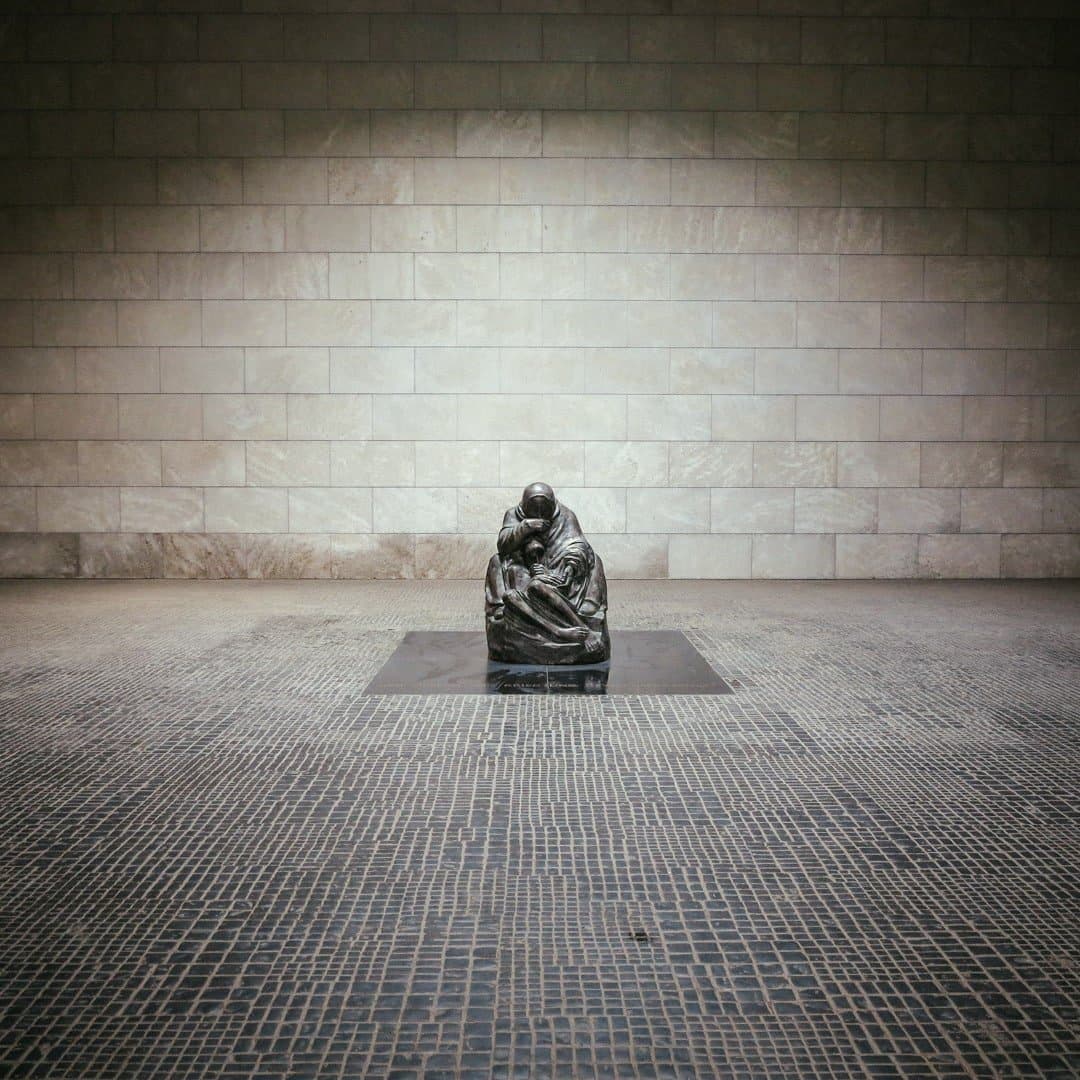
Inside the Neue Wache in Berlin: Käthe Kollwitz’s Pietà alone in the empty memorial hall under the oculus

Berlin Experiences/Featured Experiences

Neue Wache: Visit Berlin’s Memorial to the Victims of War and Tyranny

Germany’s central Memorial for the Victims of War and Tyranny.

The short answer

The Neue Wache is the Central Memorial of the Federal Republic of Germany for the Victims of War and Tyranny: a small Neoclassical guardhouse by Karl Friedrich Schinkel at Unter den Linden 4 in Berlin-Mitte, between the Humboldt University and the Deutsches Historisches Museum. You can walk straight in. Inside the bare hall is a single sculpture, an enlarged copy of Käthe Kollwitz’s Mother with her Dead Son, lit by a round opening in the roof. Entry is free, it is open daily 10:00–18:00, and most visits take 10–20 minutes.

Where
Unter den Linden 4, 10117 Berlin-Mitte
Open
Daily 10:00–18:00; closed 24 Dec
Admission
Free
Time needed
10–20 minutes
Nearest station
U5 Museumsinsel, 2 minutes on foot
Step-free
Yes: step-free access since 2017

The story · by Matt Robinson

Despite the important contributions of two of Germany’s most revered artists to its aesthetic, neither would live to see the Neue Wache in its current – and perhaps ultimate – form.

This two storey structure, designed by 19th century master architect, Karl Friedrich Schinkel, contains one of the most recognisable works of celebrated Berlin sculptress, Käthe Kollwitz, and stands nestled in a grove of chestnut trees on the eastern side of the city’s famous Unter den Linden boulevard. A testament to the ideological fluctuations of 20th century Germany, the Neue Wache has taken many different forms since its construction in 1818.

In stark contrast to its inception as a Prussian guard house – once emblematic of the military might of one of Europe’s most significant powers – it now stands as a memorial dedicated to the ‘Victims of War and Tyranny’. Fittingly not to German victims, or victims of German war or tyranny, but in the intentional ambiguity of its name, a memorial to all victims of all wars and tyranny. A monument that attracts thousands of tourists each year, who no doubt largely stumble across this humble Neoclassical structure on the city’s main historic boulevard and former Prussian via triumphalis, rather than are drawn to it by its reputation. But also visiting foreign dignitaries, politicians, heads of state, and ambassadors – tasked as representatives of nations here to pay their respects.

…a memorial to all victims of all wars and tyranny.

Schinkel’s guardhouse

As Karl Friedrich Schinkel’s first major commission in Berlin, it is certainly fair to say that the Neue Wache lacks the grandeur of his later projects – such as the nearby Altes Museum and the Konzerthaus on Berlin’s Gendarmenmarkt. Although despite its more modest proportions, this building still bears all of the typical hallmarks of a Schinkel design.

One of the leading exponents of Neoclassicism in architecture – in particular Greek Revivalism – Karl Friedrich Schinkel would serve as the head of Prussia’s prestigious Building Commission and play a significant role in transforming Berlin into a capital fit for one of Europe’s leading imperial powers. Instrumental in introducing gas lighting to the city, he would also design the most significant military decoration in the Kingdom of Prussia – the Iron Cross.
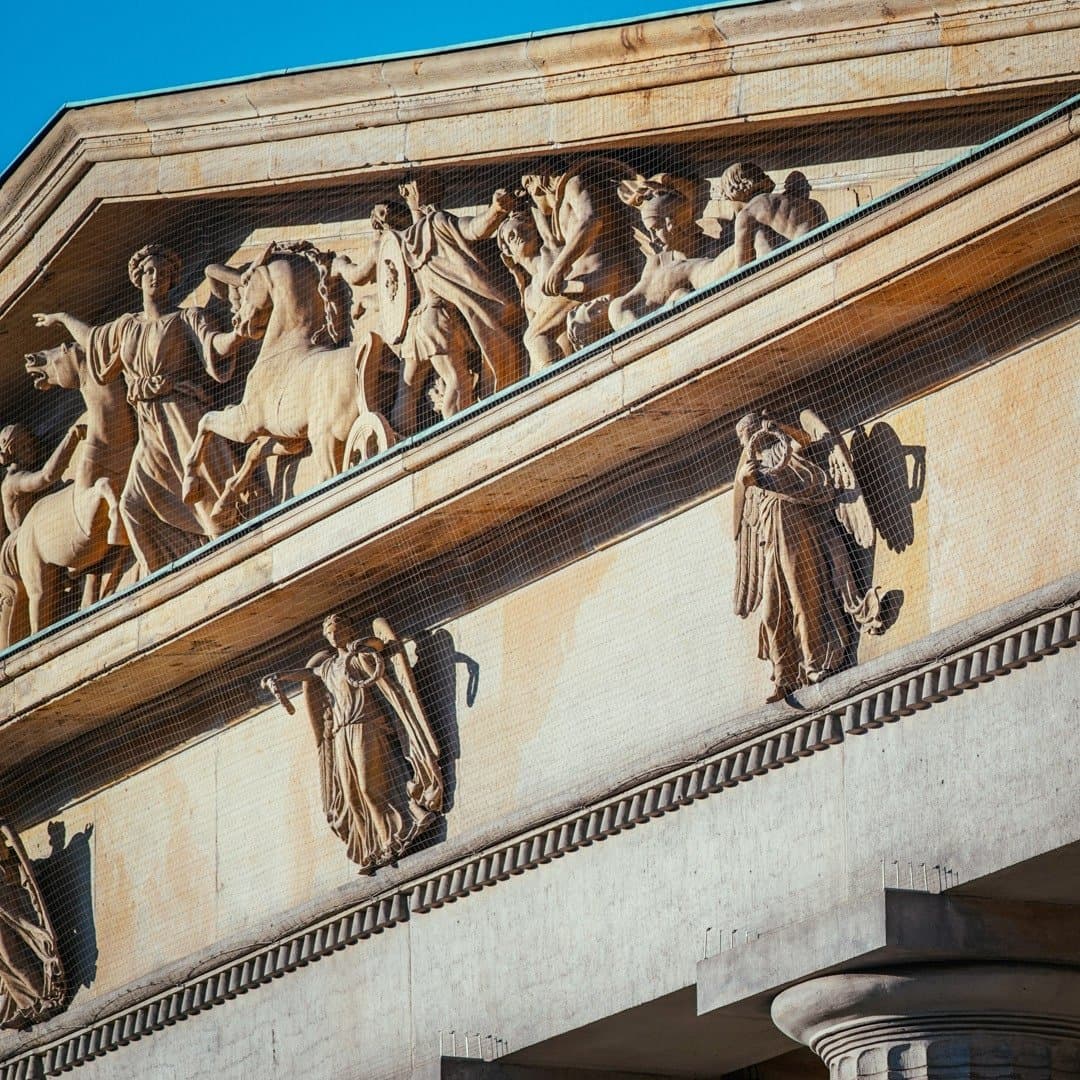
The pediment of the Neue Wache in Berlin: August Kiß’s battle relief with Victoria, above Schinkel’s carved goddesses of victory
The pediment relief, added in the 1840s after Schinkel’s death.

With its proportions intentionally reminiscent of a Roman military fort, the Neue Wache would be originally opened to house the soldiers of the Prussian King’s First Regiment and realised in the wake of the defeat of Napoleon Bonaparte’s forces in the War of Liberation. Evidence of this symbolic connection can be seen in the tympanum above the door, depicting the Greek goddess Nike deciding a battle – although this particular detail was not added until after Schinkel’s death.

From guardhouse to memorial

While the interior would initially serve as quarters for the King’s soldiers, the building would be repurposed, redesigned, and reopened in 1931. Its new form the work of architect Heinrich Tessenow, a contemporary of Walter Gropius and Mies van der Rohe, and mentor to Adolf Hitler’s architect-confidant Albert Speer – who also served as Tessenow’s assistant.
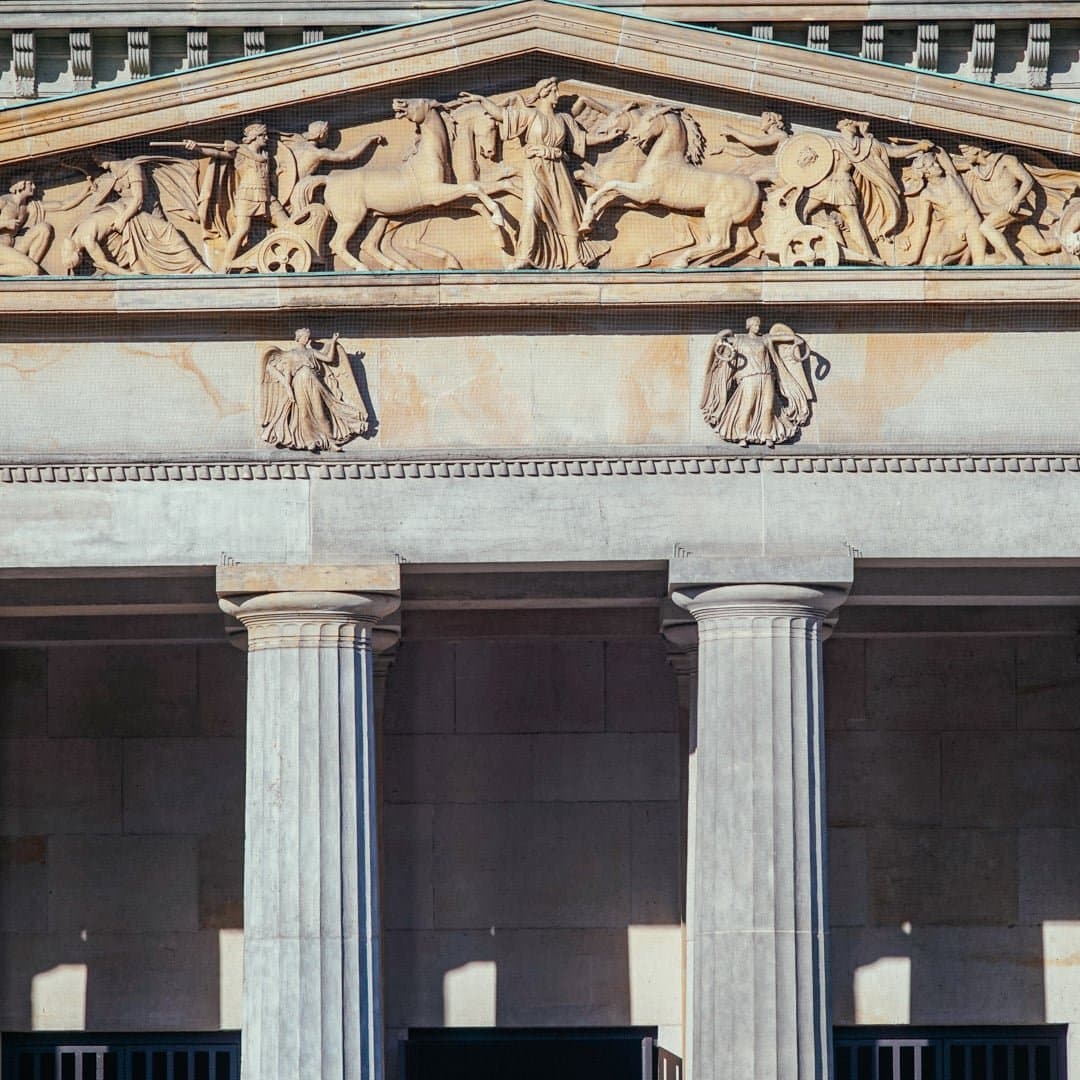
Doric columns and carved Victorias on the portico of the Neue Wache, Unter den Linden, Berlin
Schinkel’s Doric portico, with the open gates to the hall.

Rather than a guardhouse, the Neue Wache would from that point serve as the Prussian state government’s memorial for the victims of the Great War – the men who had died in the First World War. The interior of the structure gutted and transformed into a memorial hall centered around a black granite block with an oak wreath. Above the granite block, the building open to the sky through a circular skylight (an Oculus), similar in appearance to the ceiling of the Pantheon in Rome.

…the building open to the sky through a circular skylight…

When, following the end of the Second World War, the building fell into the hands of the East German government, it would again be transformed – this time into a memorial for the ‘Victims of Fascism and Militarism’. With a commemorative eternal flame added to replace the wreath, and the body of an unknown concentration camp inmate laid to rest beside that of an unknown soldier.

The memorial today

To step inside the Neue Wache today is to be confronted by a different memorial – with the similarly empty interior now interrupted by another eye catching detail – that of a small bronze statue of a mother holding her dead son in her arms. Placed directly under the Oculus – and on top of the remains of the unknown soldier and concentration camp victim.
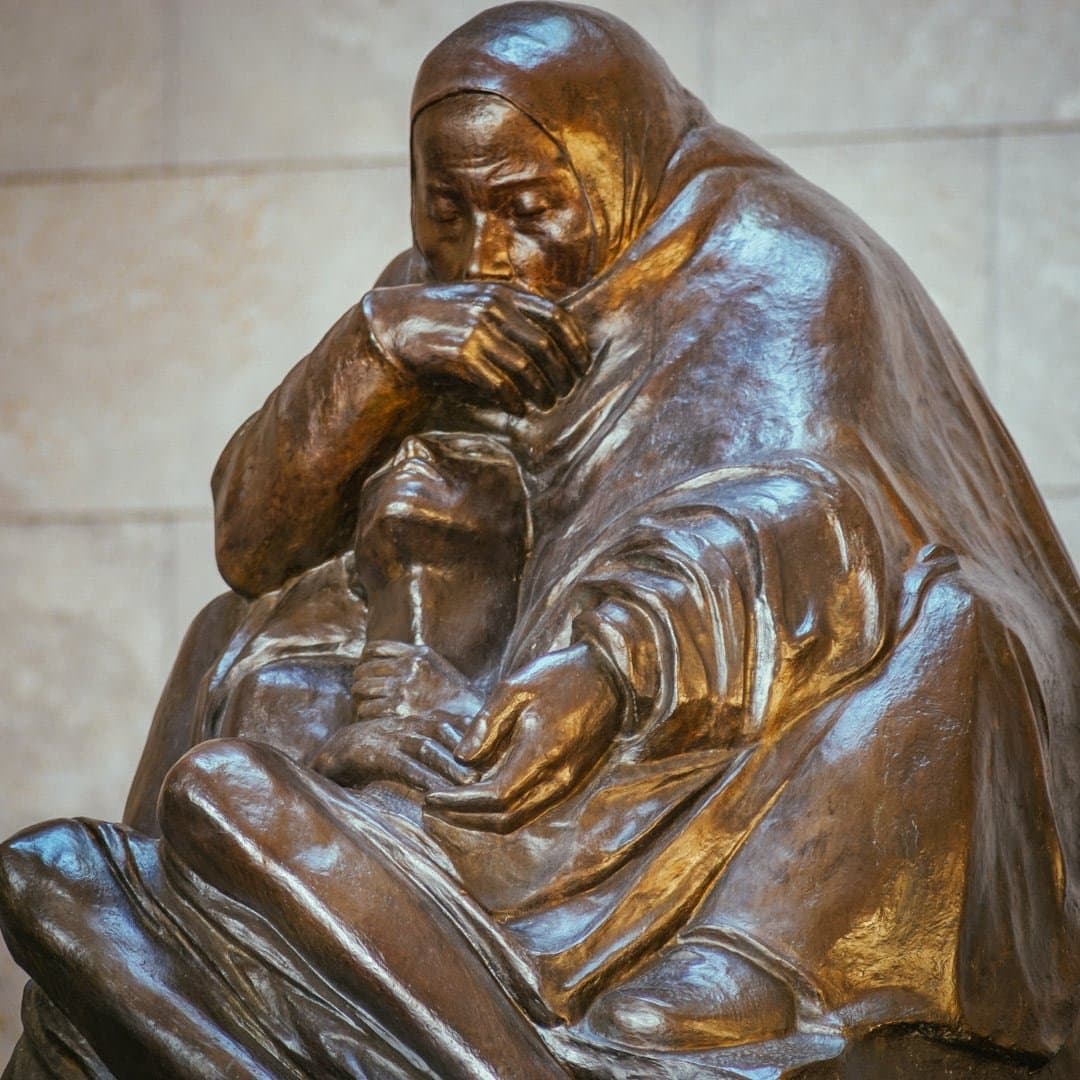
Close-up of Käthe Kollwitz’s Mother with her Dead Son, the bronze Pietà inside the Neue Wache in Berlin
Mother with her Dead Son, after Käthe Kollwitz.

Reminiscent of Michelangelo’s Pietà housed in St. Peter’s Basilica in Vatican City, this provocative sculpture was the work of Prussian artist Käthe Kollwitz – famous for her depictions of the effects of war and poverty on the lives of the poor. In this instance secularising traditional imagery of Christian suffering to address social justice issues.

Both Schinkel and Kollwitz were born in Prussia, a once mighty European power that now no longer exists. But one of the things that Prussia has come to represent in the minds of many still does – militarism, war, suffering by any other name. Philosopher George Santayana would say that only the dead know the end of war. While the suffering continues without conclusion, its victims have a memorial in Berlin waiting for them. A place of contemplation and peaceful reflection. In a country that has, in only the last 100 years, experienced so much conflict and destruction.
The Neue Wache in detail

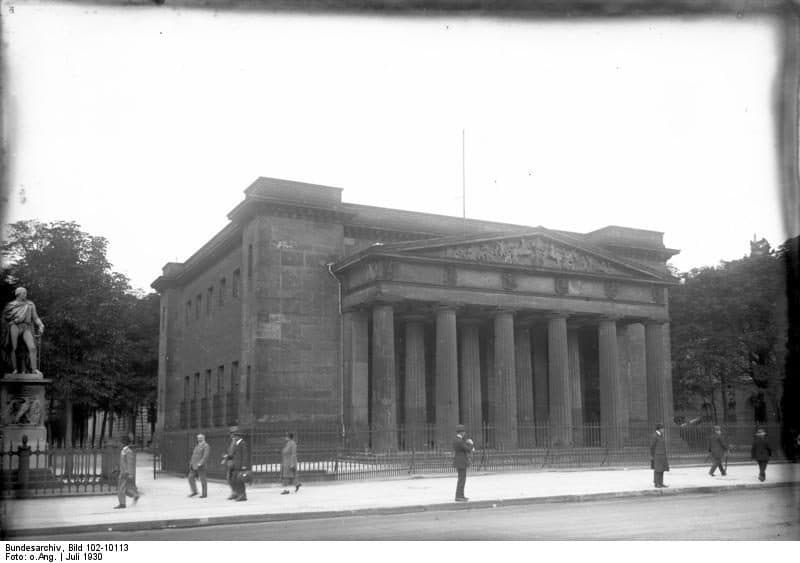
Schinkel’s Neue Wache guardhouse on Unter den Linden in Berlin in July 1930, with one of Rauch’s marble generals on the left
The guardhouse in July 1930, shortly before its conversion, with one of Rauch’s marble generals. Photo: Bundesarchiv, Bild 102-10113 / CC-BY-SA 3.0

A guardhouse for the king

The Neue Wache replaced an older guardhouse opposite the palace of King Frederick William III, who corrected Schinkel’s site plan himself in pencil. It was built in 1816–18, and on 18 September 1818, during a visit by Tsar Alexander I, soldiers of the Alexander Regiment mounted the first guard. Until 1918 it was the main royal guard of Berlin, but it was also read from the start as a monument to the wars against Napoleon: Christian Daniel Rauch’s marble statues of the generals Bülow and Scharnhorst were set up on either side of it in 1822.

August Kiß finished the zinc pediment relief in 1842–46. It stayed a working guardhouse: in October 1906 the ‘Captain of Köpenick’, the cobbler Wilhelm Voigt in a second-hand uniform, arrested the mayor of Köpenick and his chief cashier, then had them brought to Berlin and handed over to the duty officer here. On 1 August 1914 Germany’s mobilisation for the First World War was announced from the building.

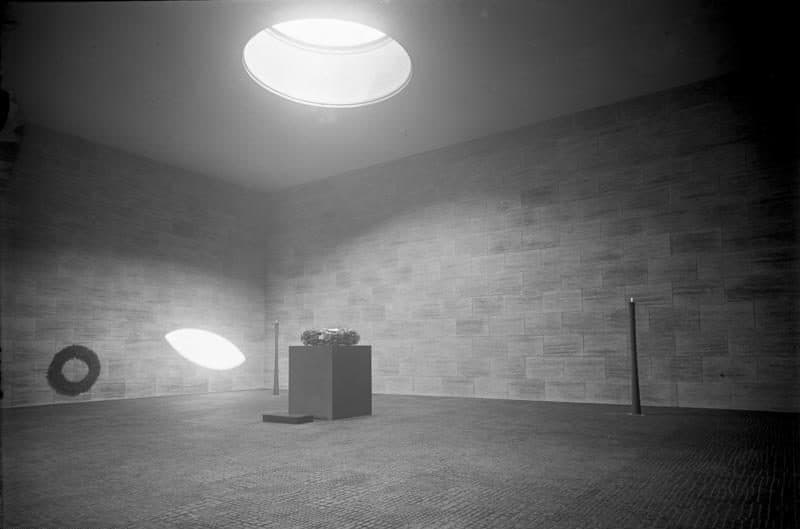
Inside Heinrich Tessenow’s memorial hall at the Neue Wache in Berlin, June 1931: the granite block and oak wreath beneath the oculus
Tessenow’s hall at its opening in June 1931: the granite block and wreath under the oculus. Photo: Bundesarchiv, Bild 102-11786 / CC-BY-SA 3.0

Tessenow’s memorial hall, 1931

After 1918 the guard was gone and the building stood empty. In 1930 the Prussian state government held a competition to turn it into a memorial to the dead of the First World War; Mies van der Rohe was among the entrants, but Heinrich Tessenow won. He roofed over the old inner courtyard, leaving only the round oculus, and placed a block of black granite in the centre carrying a silver and gold oak wreath by Ludwig Gies. The memorial opened in June 1931.

The plainness did not survive the Nazis for long. From 1934 the hall became the ‘Reichsehrenmal’, with a large cross on the rear wall, and the regime staged its Heroes’ Remembrance Day parades outside. An air raid burned the building out during the war, and in 1945 it stood as a ruin in the fought-over centre of Berlin.

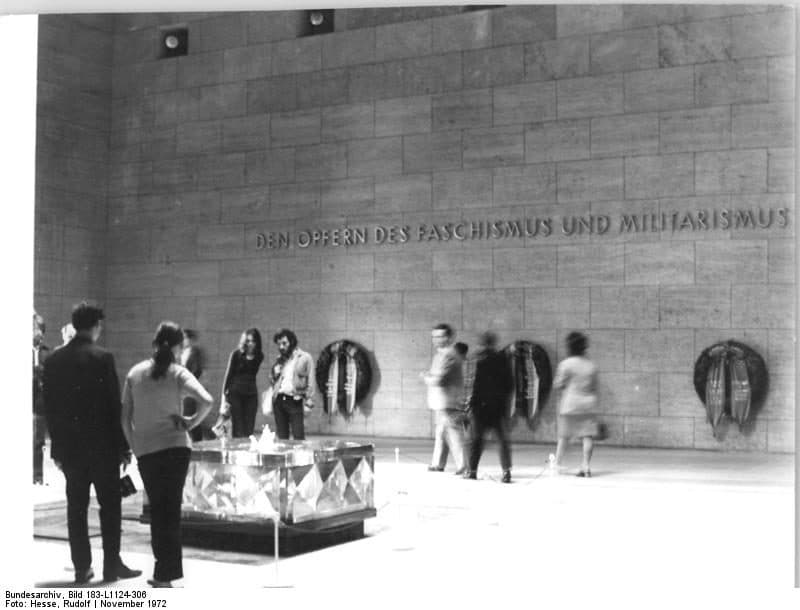
The Neue Wache in East Berlin, 1972: visitors at the glass prism with the eternal flame, beneath the inscription to the victims of fascism and militarism
The East German memorial hall in 1972, with the eternal flame in its glass prism. Photo: Bundesarchiv, Bild 183-L1124-306 / Hesse, Rudolf / CC-BY-SA 3.0

East Germany, the flame and 1993

East Germany restored the ruin and reopened it on 8 May 1960 as the Memorial to the Victims of Fascism and Militarism. In 1969 a glass prism with an eternal flame was added, and the remains of an unknown soldier and an unknown concentration camp prisoner were buried beneath it, with earth from battlefields and camps. From 1962 two soldiers of the Friedrich Engels Guard Regiment stood outside every day, and a goose-stepping changing of the guard on Wednesdays and Saturdays became one of East Berlin’s sights.

After reunification Chancellor Helmut Kohl chose Kollwitz’s small sculpture of 1937–38 for the new national memorial, and the sculptor Harald Haacke enlarged it from 38 centimetres to about 1.6 metres. It was rededicated on Volkstrauertag, 14 November 1993. The choice was disputed: the historian Reinhart Koselleck was among those who argued that a Christian image of a mother and her fallen son could not stand for the murdered Jews of Europe. Bronze plaques by the entrance now name the groups of victims it remembers.

Plan your visit

Visiting the Neue Wache

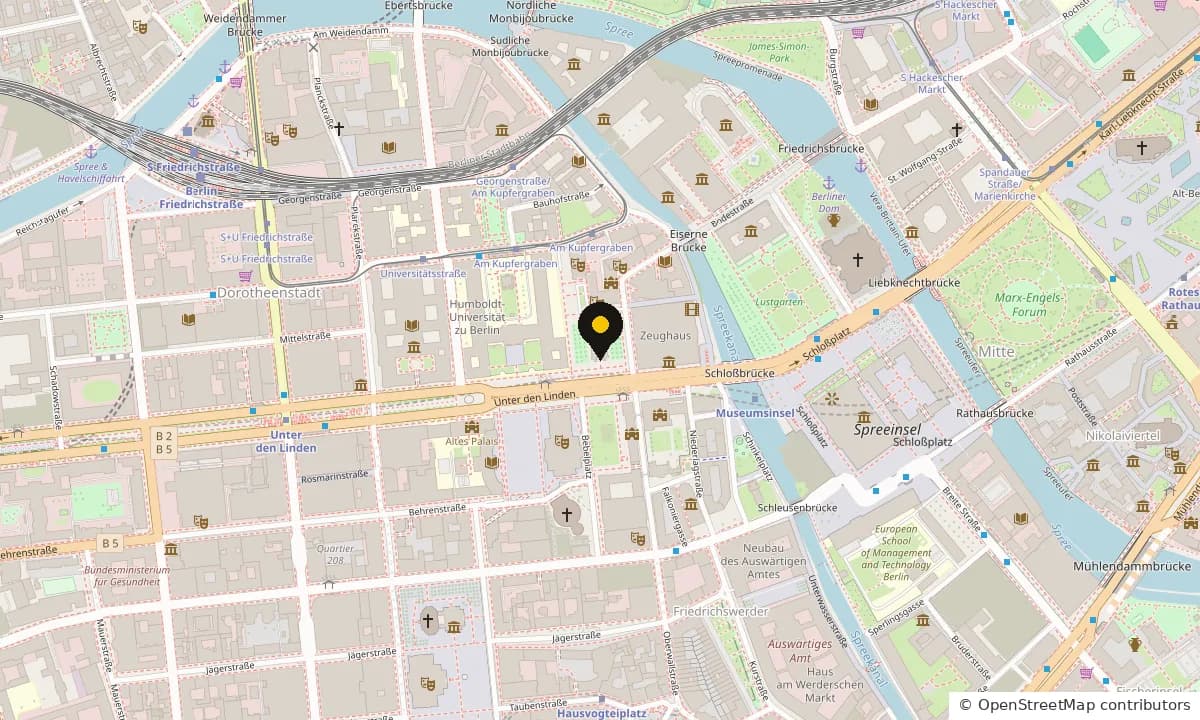
Map of the streets around the Neue Wache, with a pin on the siteOpen in Google Maps

Unter den Linden 4, 10117 Berlin · Daily 10:00–18:00. 31 December 10:00–14:00, 1 January 12:00–18:00, closed 24 December. Access is limited during state ceremonies, such as on Volkstrauertag in November.

Getting there

  • U5Museumsinsel150 m · 2 min

    Opened in 2021. Take the exit towards Unter den Linden and walk west past the Zeughaus.

  • U5U6Unter den Linden400 m · 5 min

    Walk east along Unter den Linden, past the Humboldt University.

  • Bus 100Bus 300Staatsoper100 m · 1 min

    The stop is on Unter den Linden, almost opposite the memorial.

What you’ll see

  • Schinkel’s portico of Doric columns, with carved goddesses of victory above them and a battle relief in the pediment, set against the chestnut grove beside the Humboldt University.
  • The bare memorial hall, open to the sky through a round oculus, with Käthe Kollwitz’s Mother with her Dead Son enlarged to about 1.6 metres, and the inscription ‘Den Opfern von Krieg und Gewaltherrschaft’ (To the victims of war and tyranny) set in the floor.
  • Across the road, on the green between the State Opera and the Prinzessinnenpalais, bronze statues of the Prussian generals Yorck, Blücher and Gneisenau. The marble Bülow and Scharnhorst that once flanked the guardhouse were moved to the Spandau Citadel in 2021 to protect them from the weather.

Tips from a guide

  • Go on a rainy day if you can: the oculus is open, and rain and snow fall straight onto the sculpture.
  • It is a place of mourning: keep your voice down, no flash, no food or drink and no phone calls inside. Dogs are not allowed, apart from assistance dogs.
  • Combine it with Bebelplatz and the book-burning memorial (4 minutes) and Museum Island (6 minutes): the Neue Wache rarely needs more than a quarter of an hour.

Accessibility

The memorial is listed by berlin.de as accessible, with step-free access added in a 2017 refurbishment, and the hall is one level. Of the nearby stations, check the BVG website for lift status before you travel. There are no visitor facilities or seating in the hall itself.

Timeline

From royal guardhouse to national memorial

  1. 1816–18Schinkel builds the Neue Wache as the royal guardhouse on Unter den Linden.
  2. 1822Rauch’s statues of the generals Bülow and Scharnhorst are set up beside it.
  3. 1842–46August Kiß makes the pediment relief, after Schinkel’s death in 1841.
  4. 1 Aug 1914Germany’s mobilisation for the First World War is announced from the building.
  5. 1931Tessenow turns it into Prussia’s memorial to the dead of the First World War.
  6. 1945Burned out by bombing, it stands as a ruin at the end of the war.
  7. 8 May 1960East Germany reopens it as the Memorial to the Victims of Fascism and Militarism.
  8. 1969An eternal flame is lit; an unknown soldier and camp prisoner are buried here.
  9. 1990After reunification the East German flame and fittings are removed.
  10. 14 Nov 1993Rededicated as the national memorial, with the enlarged Kollwitz sculpture.
  11. 2017Refurbished with step-free access and new lighting.

See it with a historian

Tours that stop at the Neue Wache

The hall is silent and almost empty; a guide can tell you who is buried there, why the sculpture caused a row, and how each regime rewrote this one room.

Six hours across historic Mitte, along Unter den Linden past the Neue Wache.

The Berlin History Tour
Full Day6 Hours

The Berlin History Tour

Private 6-hour van tour of Berlin's whole history in one day for up to 6 people. Starts at your hotel or anywhere in the city.

€1,000up to 6
View Tour

East Berlin’s story, including the goose-stepping guard at the Neue Wache.

The Berlin Wall Tour - Berlin Experiences
Full Day6 Hours

The Republic Of Fear

Private 6-hour van tour of East Berlin, the Stasi and life behind the Wall for up to 6 people. Starts at your hotel.

€1,000up to 6
View Tour

The highlights of central Berlin in a shorter tour.

The Bitesize Berlin Tour
Half Day3 Hours

The Bitesize Berlin Tour

Private 3-hour van tour of Berlin's major sights for up to 6 people. Starts at your hotel or anywhere in the city.

€700up to 6
View Tour

Questions visitors ask

Frequently asked questions

Is the Neue Wache free to visit?

Yes. There is no ticket and no booking: you walk in through the portico. It is open daily 10:00–18:00, closed on 24 December, with shorter hours on 31 December and 1 January.

What is inside the Neue Wache?

A single, almost empty hall with Käthe Kollwitz’s Mother with her Dead Son, enlarged by Harald Haacke to about 1.6 metres, standing directly under an open oculus. In front of it the floor reads ‘Den Opfern von Krieg und Gewaltherrschaft’, to the victims of war and tyranny.

Who is buried in the Neue Wache?

An unknown German soldier and an unknown prisoner of a Nazi concentration camp, buried in 1969 with earth from Second World War battlefields and concentration camps. They lie beneath the floor of the hall.

Why is the roof of the Neue Wache open?

Heinrich Tessenow left a round opening, an oculus, in the roof when he turned the guardhouse into a war memorial in 1931. It is still open, so rain, snow and cold fall straight onto the sculpture below.

Why was the Kollwitz sculpture controversial?

Critics in 1993, among them the historian Reinhart Koselleck, argued that a Christian-style image of a mother mourning a soldier son could not represent the murdered Jews of Europe or the women who were victims themselves. Bronze plaques listing the victims were added outside to answer some of this criticism.

Is there still a changing of the guard at the Neue Wache?

No. The East German guard and its goose-stepping ceremony ended with reunification in 1990. Today there is no guard at all; the memorial is looked after by museum staff.

Can you take photos inside the Neue Wache?

Yes, for private use and without flash. Commercial photography and filming are not allowed without permission, and visitors are asked to keep quiet and not eat, drink or use their phones inside.

Who designed the Neue Wache?

Karl Friedrich Schinkel, as his first major building in Berlin, in 1816–18. Heinrich Tessenow designed the memorial interior in 1931, which was largely restored in 1993.

Keep exploring

More Featured Experiences.

Every site we write about — 56 landmarks, museums, memorials and lesser-known corners of Berlin. See the full index →

01Walk Through The Brandenburg Gate02Explore The State Museums On Museum Island03Visit The Berlin TV Tower – The Fernsehturm04Cross The Cold War Border At Checkpoint Charlie05Visit The Site Of Adolf Hitler’s Führerbunker06Explore The Reconstructed Berlin Palace07Visit The Reichstag Cupola At Night08Explore The Forum Fridericianum09Shop At The Humboldt University Book Sale10Journey Into The Memorial To The Murdered Jews Of Europe12Explore The Former Jewish Quarter – Spandauer Vorstadt13Visit The Remains Of The Berlin Wall14Walk Across The Bridge Of Spies15Explore The Topography Of Terror16Climb The Prussian Victory Column – The Siegessäule17Enter The Palace Of Tears – The Tränenpalast18Step Inside The Berlin Olympic Stadium19Explore Erich Mielke’s Office At The Stasi Museum20Walk Along Karl Marx Allee21Visit The Oldest Church In Berlin – The Nikolaikirche22Explore The Berliner Dom23Visit The Grave Of Frederick The Great24Walk Through The Ruins Of Anhalter Bahnhof25Stand On The Platz Des Volksaufstandes26Visit The German Resistance Museum27Visit The Soviet War Memorial In The Tiergarten28See The Georg Elser Memorial On Wilhelmstrasse29Step Inside The Kaiser Wilhelm Gedächtnis Kirche30Visit The Gleis 17 Memorial31Visit The Schloss Charlottenburg Mausoleum32Climb The Französischer Dom at Gendarmenmarkt33Explore The Interbau – IBA 5734Explore The Otto Weidt Workshop35Visit Cecilienhof – Site Of The Potsdam Conference36Visit The Stasi Prison In Hohenschönhausen37Spend The Day At Tempelhof Airport38Ride The Fastest Elevator In Europe39Visit The Soviet War Memorial In Treptower Park40Visit The Sachsenhausen Concentration Camp Memorial41Visit The Ravensbrück Concentration Camp Memorial42Visit Karlshorst – The Site Of The German Surrender43Visit The Socialists Cemetery – Zentralfriedhof Friedrichsfelde44Visit The Soviet War Memorial In Pankow45Visit the Seelow Heights Memorial46Visit The Commonwealth War Cemetery47Cross The Bösebrücke At Night48Explore The Allied Museum In Dahlem49Explore The Spandau Citadel50Visit The Brandenburg T4 Euthanasia Memorial51Visit The Wannsee Conference House52Visit The Jewish Museum53Visit The Jewish Cemetery In Weissensee54Walk Along The East Side Gallery55Explore The Volkspark Friedrichshain Flak Tower56Head Up The Teufelsberg