Skip to content
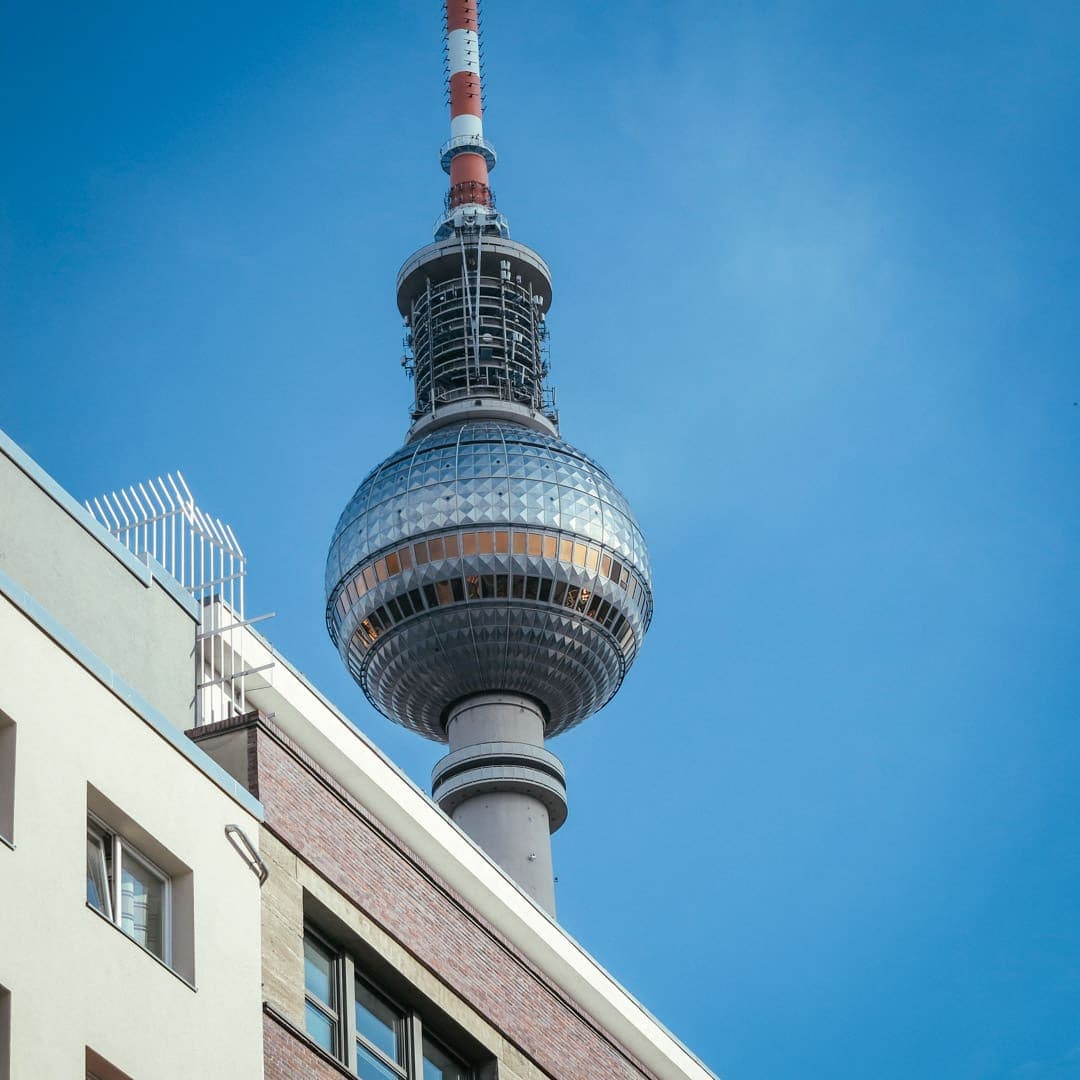
The Berlin TV Tower (Fernsehturm) at Alexanderplatz against a blue sky, its silver sphere and red-and-white antenna above the rooftops

Berlin Experiences/Featured Experiences

Berlin TV Tower: Visit the Fernsehturm at Alexanderplatz

East Germany’s Sputnik on a stick, and still the tallest structure in Germany.

The short answer

The Berlin TV Tower, or Fernsehturm, is the 368-metre television tower at Alexanderplatz in Berlin-Mitte: the tallest structure in Germany, opened by East Germany on 3 October 1969. You can go up: lifts take you to an observation deck at 203 metres in about 40 seconds, and the revolving Sphere restaurant is one floor above. It is not free: tickets start at €20, are tied to a time slot and are best booked online. Allow about an hour; time on the deck is limited to 45 minutes.

Where
Panoramastraße 1A, 10178 Berlin-Mitte, at Alexanderplatz
Open
Mar–Oct 09:00–23:00, Nov–Feb 10:00–23:00
Admission
From €20, timed tickets; book online
Time needed
About 1 hour (45 minutes on the deck)
Nearest station
S+U Alexanderplatz, 4 minutes on foot
Step-free
No: wheelchair users cannot go up

The story · by Matt Robinson

For a city built on a swamp – in a region known for its sandy and unforgiving topography – it is quite incredible that Berlin can boast of having the tallest structure in Germany, located in the heart of its historic Mitte district.

Completed in 1969, by the East German government, the Television Tower (or Fernsehturm as it is known in German), originally stood 365m high – making it the third highest standing structure in the world on completion. After the Ostankino in Moscow and the Empire State building in New York. The height of the structure, a direct reference to the number of days in the year; making it easy for school children in the German Democratic Republic to remember. Following German reunification in 1990 –  it grew a further 3 metres  with the addition of a larger antenna, in 1997.

Its iconic shape has understandably led to it acquiring a number of descriptive monikers – the rocket ship, the Tele-asparagus (a reference to the vegetable grown in the region), the disco-ball in the sky – and for Star Wars fans…the Death Star.

Despite its age – and provenance in a country that no longer exists – the TV Tower still stands significantly higher than any of the other buildings in Berlin – now a whole 368 metres to the top.

No other building in the German capital sits so definitively on the skyline of the city; so clearly towering, as it does, over everything around it.

A Sputnik over Alexanderplatz

Instantly recognisable not only due to its height, the TV Tower’s design is clearly reminiscent of the Stuttgart Fernsehturm, the first telecommunications tower in the world to be constructed using reinforced concrete – completed 13 years before its Eastern counterpart. Although the Berlin structure consists of a similar central reinforced concrete shaft (248 metres in height) the tiled stainless steel dome here is said to have been inspired by the Soviet Sputnik satellite launched into space in 1957.
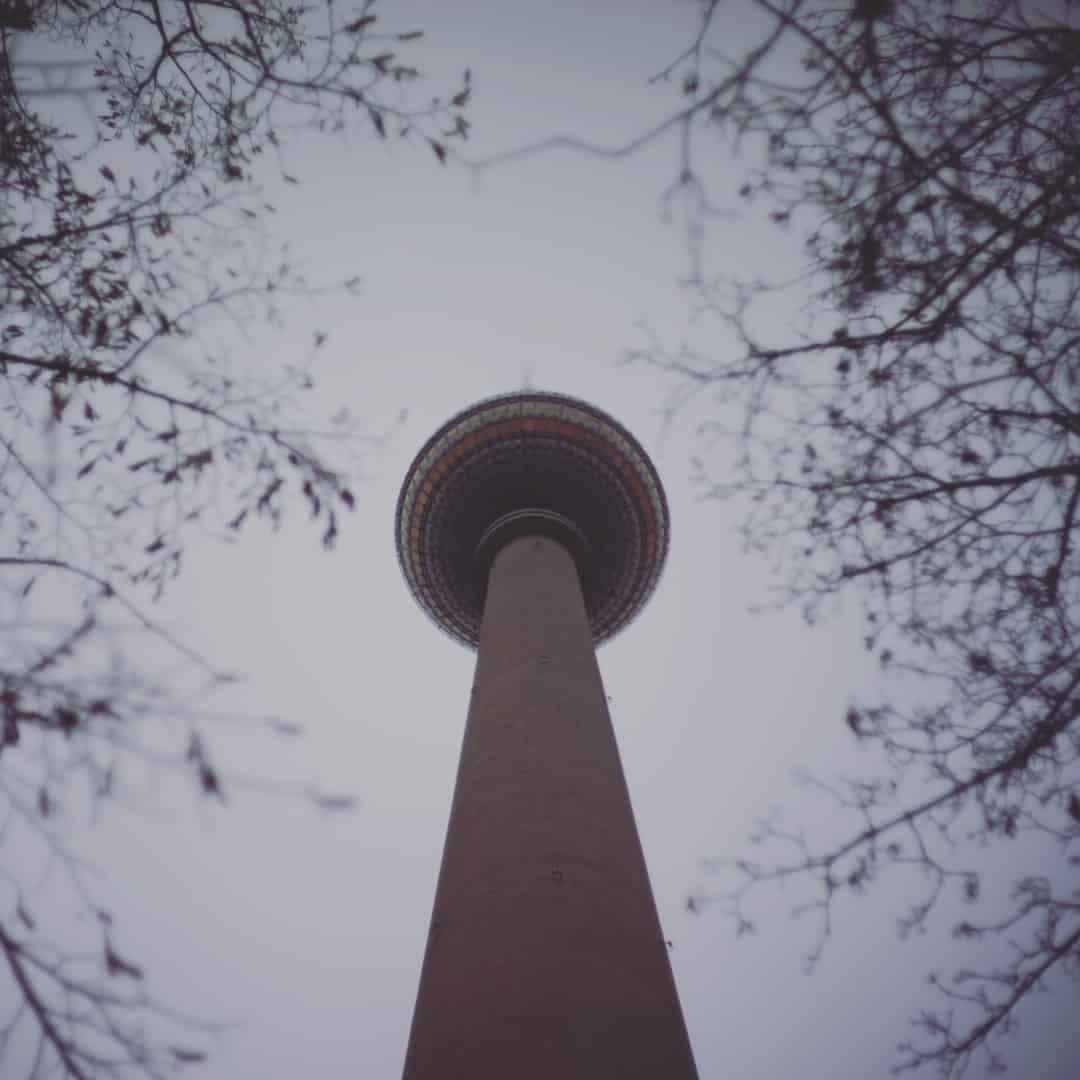
Looking straight up the concrete shaft of the Berlin TV Tower to the sphere, framed by bare winter branches
The 248-metre concrete shaft, from the foot of the tower.

From inside this ball it is possible to gaze over 40km to the horizon from a panoramic platform – located at a height of about 203 metres (666 feet). One floor above this viewing area is the Sphere restaurant (the former Telecafé) – at 207 metres (679 feet) – officially the highest eatery in the city. Not only are diners greeted with the same view as the visitors to the observation deck below, but also experience the rotation of the restaurant, which completes a full circle over the space of 30 minutes.

Access to both the restaurant and viewing platform is possible using one of two lifts, that depart from the entrance at the foot of the tower, and shuttle visitors to the viewing deck in a speedy 40 second travel time. There is also stair access – consisting of a gruelling 986 steps – but it is reserved for emergencies and staff.

A tower for the Cold War

While the structure is commonly referred to as the TV Tower (or Fernsehturm), its official designation was the Fernseh- und UKW-Turm Berlin (Television and VHF Tower Berlin) – built to broadcast colour television in East Germany and improve on the poor coverage of broadcasting signals throughout the country.

Beyond its practical purpose, it also served as a symbol of the technological advancements of the East – during the tense Cold War period of the 1960s. Centrally located in the city; and an expression of the ideological aspirations of the Soviet system. When construction was started, the ruling party leadership in East Germany – led by Socialist Unity Party leader Walter Ulbricht – had decided to locate the tower right in the heart of the East German capital, near the historic birthplace of Berlin, and next to the Alexanderplatz train station.
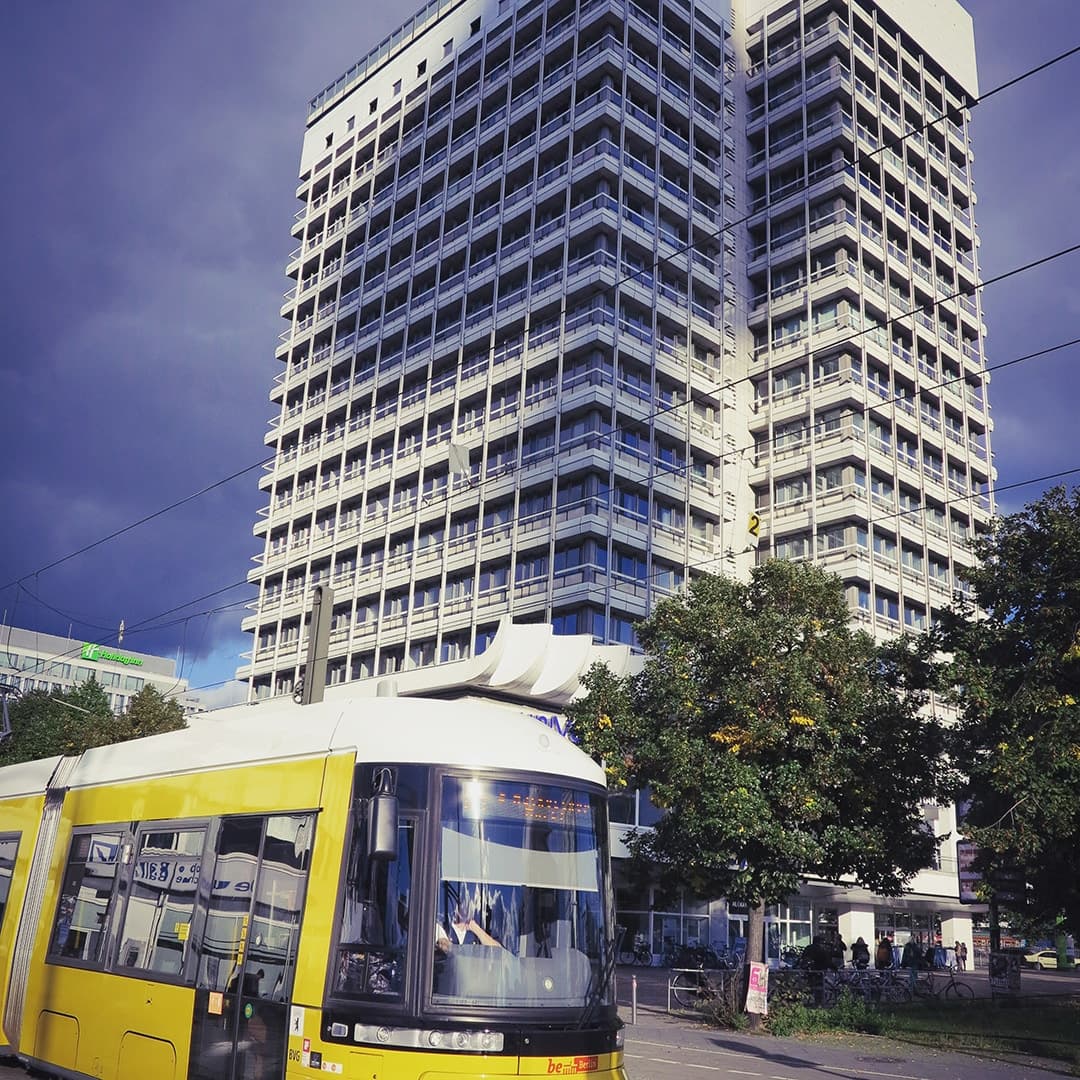
A yellow Berlin tram passing an East German high-rise in the city centre near Alexanderplatz
East Berlin’s new centre, built around the tower in the late 1960s.

While under construction, the Soviet Union could proudly boast its successes in the most significant propaganda campaign of the time – the so-called Space Race. With Soviet cosmonauts leading the way not only with the first man (Yuri Gagarin) and woman (Valentina Tereshkova) in space, the first space walk, but also the first animals to successfully orbit the earth (Belka and Strelka), and the first probe on the moon.

When the Television Tower was completed and unveiled to the world on October 3rd 1969, the United States had however just managed to eclipse these earlier Soviet achievements with one giant step – the first man on the moon.

The tower can see you

To see the TV Tower solely as what it represents now is to miss the opportunity to understand the importance of its problematic place in the Cold War conflict between East and West. It is now one of the ten most popular tourist attractions in Germany, with more than 1 million visitors per year. But following its completion, it gave millions of East Germans the opportunity to experience something that they had been denied since 1961 – to gaze over the Berlin Wall and clearly into the capitalist West of the divided city.

…to gaze over the Berlin Wall and clearly into the capitalist West of the divided city.

However, as a constant symbol of the collective achievements of the East – the Soviet Union and East Germany – the TV Tower stood in the centre of East Berlin and visible from all angles. A god’s eye in the sky – the perfect encapsulation of 18th century British theorist Jeremy Bentham’s idea of the Panopticon. For as East Germany would grow to have proportionally the largest secret police force in human history, the Stasi – bigger for the size of its population even than the KGB was for the entire Soviet Union – the tower would serve to represent the central dominance of the party and state over everyday life and East German society.
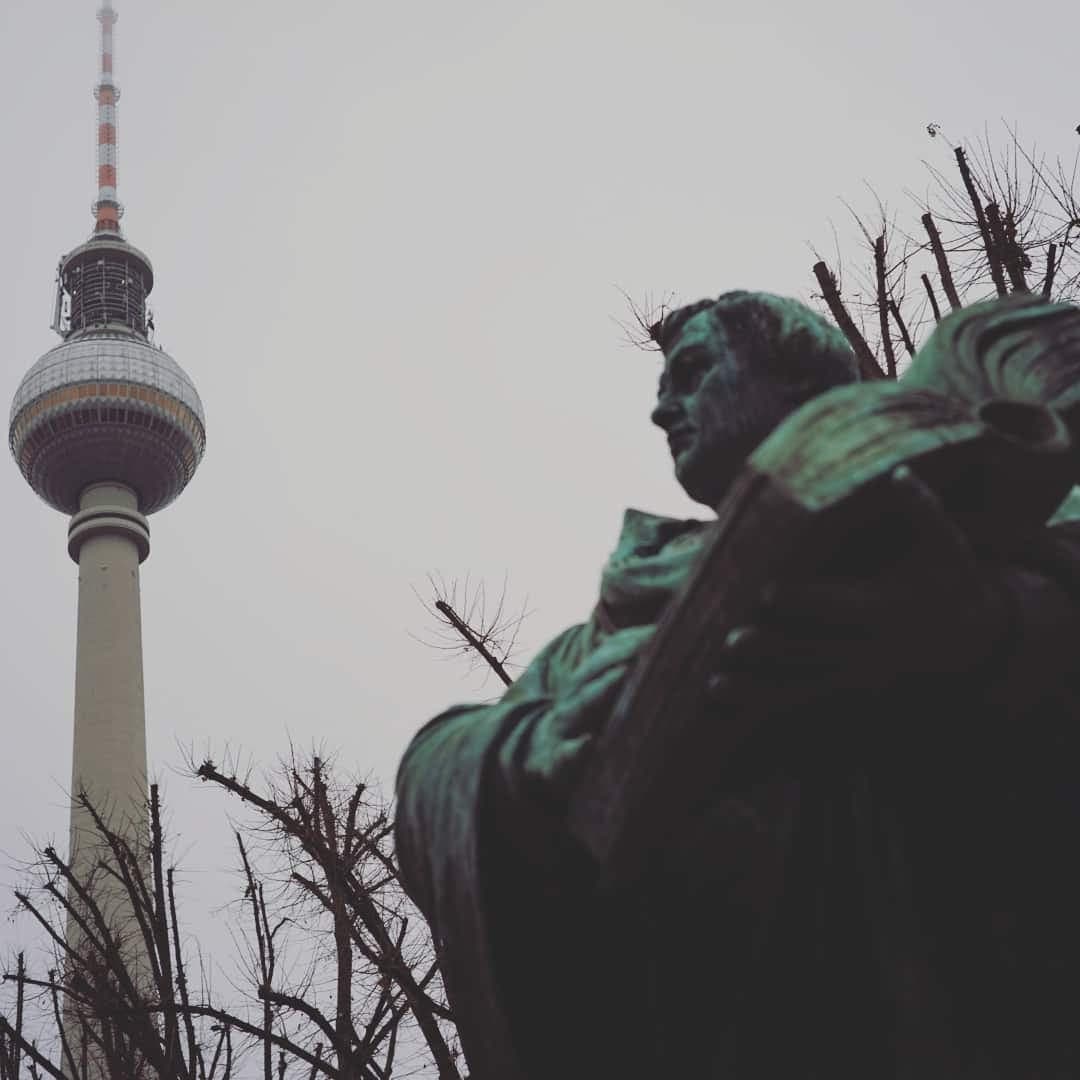
The Berlin TV Tower rising behind the Martin Luther statue at the Marienkirche, Alexanderplatz
Martin Luther outside the Marienkirche, with the tower behind.

Omnipresent – and through the clouded glass of the Sputnik shaped dome perhaps also hiding something omniscient and omnipotent.

For where you can see the tower – the tower can also see you.
The TV Tower in detail

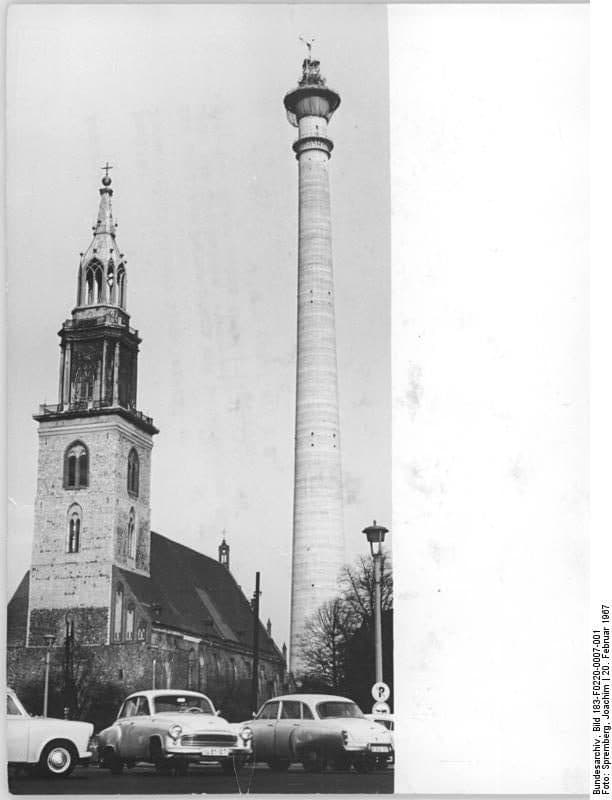
The half-built concrete shaft of the Berlin TV Tower rising beside the Marienkirche, February 1967
The shaft, already more than 200 metres high, beside the Marienkirche in February 1967. Photo: Bundesarchiv, Bild 183-F0220-0007-001 / Spremberg, Hans-Joachim / CC-BY-SA 3.0

How the TV Tower was built

East Germany first planned its main broadcasting tower for the Müggelberge hills in the south-east of the city, and building had already started there in the 1950s when the site was dropped: it lay in the approach path of the new Schönefeld airport. In the 1960s the government moved it to the centre of the capital, where it would show off what socialism could build. The original design of a slender tower soaring skywards came from the architect Hermann Henselmann; the team that worked it up included Fritz Dieter, Günter Franke and Werner Ahrendt.

Foundation work began on 4 August 1965. The shaft rose on climbing formwork, its inner steel scaffold growing a step ahead of the concrete, and the steel frame of the sphere was made on the ground and lifted in segments to about 200 metres. At more than 132 million marks, the tower cost at least four times what had been planned.

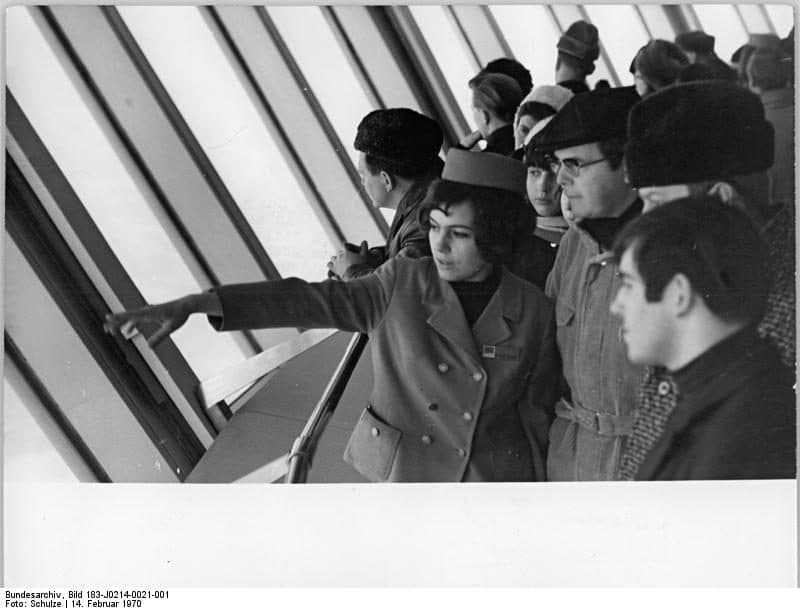
Visitors at the sloping windows of the Berlin TV Tower observation deck as a hostess points out the view, February 1970
A hostess points out the new East Berlin to visitors on the observation deck, February 1970. Photo: Bundesarchiv, Bild 183-J0214-0021-001 / Schulze / CC-BY-SA 3.0

The observation deck and the restaurant

Visitors ride in one of two lifts that climb at 6 metres a second and reach the observation deck at 203 metres in about 40 seconds; a third lift serves the staff. The deck looks out through the sloping windows of the sphere, and one floor above, at 207 metres, is the revolving restaurant, opened as the Telecafé. Until the late 1990s it turned once an hour; today it turns once every 30 minutes, the tables moving past the windows while the deck below stays still.

The tower was a hit from the start. Four million people went up in its first three years, and 1.3 million people went up in 1978 alone. Today about a million a year still do, which is why tickets are now sold in time slots, with 45 minutes on the deck and up to 1 hour 45 minutes in the restaurant.

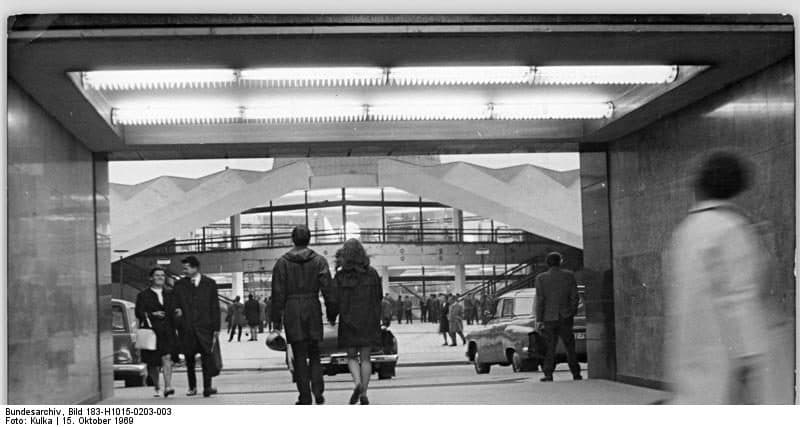
The folded-roof entrance pavilion of the Berlin TV Tower seen through an underpass from Alexanderplatz station, October 1969
The new entrance pavilion seen from Alexanderplatz station, October 1969. Photo: Bundesarchiv, Bild 183-H1015-0203-003 / Kulka / CC-BY-SA 3.0

The pavilions and the square

The tower was the centrepiece of a new socialist city centre. What the war had left of the old streets between Alexanderplatz and the Spree was cleared to make room for it, leaving the medieval Marienkirche standing on its own in a wide open space. Around the foot of the shaft, between 1968 and 1972, the architects added low pavilions around the entrance, crowned with sharply folded concrete roofs that are still the first thing you see when you leave the S-Bahn.

East Germany put the tower under monument protection in 1979, and it stayed listed after reunification. Since then it has become a symbol of the whole city rather than just the East: like the Brandenburg Gate, it now stands for reunified Germany. The visitor areas were modernised in 2012 and the forecourt was redesigned in 2013, but the folded roofs are still there.

Plan your visit

Visiting the TV Tower

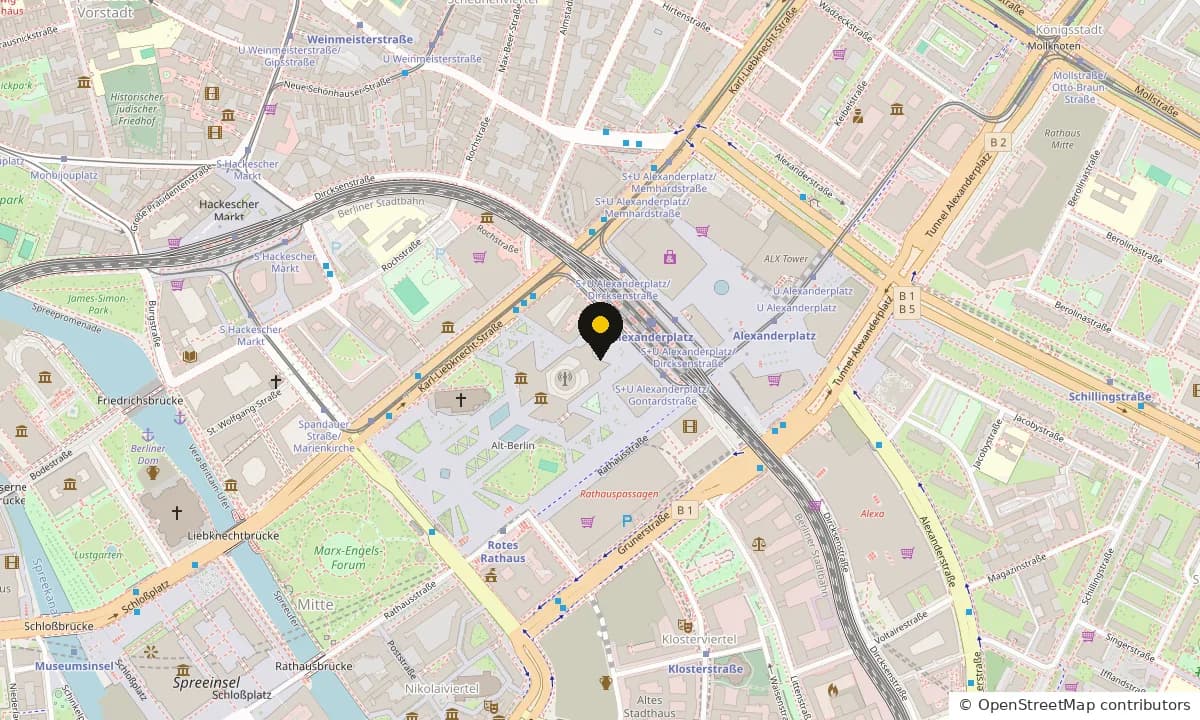
Map of the streets around the TV Tower, with a pin on the siteOpen in Google Maps

Panoramastraße 1A, 10178 Berlin · March–October daily 09:00–23:00; November–February daily 10:00–23:00. 24 December 10:00–16:00. Closed 10 March (maintenance) and 23 November 2026. Check tv-turm.de before you go.

Getting there

  • S3S5S7S9U2U5U8Alexanderplatz280 m · 4 min

    Regional trains RE1, RE2 and RE7 stop here too. The tower’s entrance pavilion faces the S-Bahn station across the square.

  • U5Rotes Rathaus340 m · 4 min

    Opened in 2020. Come up by the Red Town Hall and walk north past the Neptune Fountain.

  • Bus 100Bus 200Tram M4Tram M5Tram M6Spandauer Str./Marienkirche450 m · 6 min

    Buses 100 and 200 run along Unter den Linden: an easy, cheap sightseeing ride from the Brandenburg Gate.

What you’ll see

  • The 360° view from the observation deck at 203 metres: on a clear day you can pick out the Brandenburg Gate, the Reichstag dome, Museum Island and the old airfield at Tempelhof.
  • The Sphere restaurant one floor up, at 207 metres, which turns once every 30 minutes, and the Sphere Bar, included in a standard ticket.
  • At the foot of the tower: the 1960s entrance pavilions with their folded roofs, the medieval Marienkirche, the Neptune Fountain and, across the railway bridge, the World Clock on Alexanderplatz.

Tips from a guide

  • Book a time slot online before you go: every ticket is tied to one, with 15 minutes’ grace, and you can rebook online up to 10 minutes before.
  • Pack light. Security is airport-style, suitcases and shopping bags are not allowed, backpacks may be no bigger than 45 × 35 × 20 cm and there are no lockers. Prams stay in the cloakroom.
  • Look at the sky before you pay: on low grey days the sphere can sit inside the cloud. Children under 15 must come with an adult aged 18 or over.

Accessibility

The TV Tower is not accessible to wheelchair users. The operator does not admit wheelchair users or visitors who cannot move around without help or aids, because they could not be brought down the 986-step stairwell in an emergency (the lifts cannot be used in a fire). Prams cannot go up either; they can be left in the cloakroom for free. Holders of a severely disabled ID card get a discount at the box office. S+U Alexanderplatz has lifts: check the BVG website for their status.

Timeline

From East Berlin showpiece to Berlin’s landmark

  1. 1950sA first broadcasting tower site in the Müggelberge hills is abandoned.
  2. 4 Aug 1965Foundation work begins in the centre of East Berlin.
  3. Feb 1967The concrete shaft passes 200 metres.
  4. Early 1969Water gets into the sphere and causes serious damage.
  5. 3 Oct 1969Walter Ulbricht opens the tower, days before East Germany’s 20th anniversary.
  6. 7 Oct 1969The tower opens to the public.
  7. 1979The tower is listed as a protected monument.
  8. 12 Jun 1987Ronald Reagan mentions the cross of light on the sphere in his Berlin Wall speech.
  9. 1997A new antenna tip takes the tower from 365 to 368 metres.
  10. 14 Jun 2011The 50-millionth visitor goes up.
  11. 2025The revolving restaurant reopens as Sphere, with chef Tim Raue.

See it with a historian

Tours that stop at the TV Tower

From the deck you see the whole city; a guide on the ground tells you why East Berlin built it here, and what the people living under it made of it.

Life behind the Iron Curtain, from Alexanderplatz and the tower to Karl-Marx-Allee and the Stasi.

The Berlin Wall Tour - Berlin Experiences
Full Day6 Hours

The Republic Of Fear

Private 6-hour van tour of East Berlin, the Stasi and life behind the Wall for up to 6 people. Starts at your hotel.

€1,000up to 6
View Tour

A full day through Berlin’s history, with Alexanderplatz and the TV Tower on the route.

The Berlin History Tour
Full Day6 Hours

The Berlin History Tour

Private 6-hour van tour of Berlin's whole history in one day for up to 6 people. Starts at your hotel or anywhere in the city.

€1,000up to 6
View Tour

Four hours on foot through the historic centre, at your own pace.

The Berlin Explorer Tour
Half Day4 Hours

The Berlin Explorer Tour

Private half-day walking tour of historic Mitte for up to 10 people. Starts at your hotel or anywhere in the centre.

€500up to 10
View Tour

Questions visitors ask

Frequently asked questions

How tall is the Berlin TV Tower?

368 metres to the tip of the antenna. It was 365 metres when it opened in 1969 and gained 3 metres when a new antenna tip was fitted in 1997. It is the tallest structure in Germany.

How high is the observation deck?

203 metres. The revolving Sphere restaurant is one floor above, at 207 metres. On a clear day you can see about 40 kilometres.

How much does it cost to go up the Berlin TV Tower?

Standard tickets start at €20 on tv-turm.de and include the observation deck and the Sphere Bar. Packages with a drink or a meal in the Sphere restaurant cost more.

Do I need to book the TV Tower in advance?

It is strongly advised. Every ticket is tied to a time slot, and you can buy them online up to 90 days ahead or at the box office if any are left. Tickets can be rebooked online up to 10 minutes before your slot.

How long do you need at the TV Tower?

About an hour including security and the lift. Your stay on the observation deck is limited to 45 minutes, and a restaurant booking to 1 hour 45 minutes.

Can you walk up the stairs of the TV Tower?

No. The staircase has 986 steps, but it is reserved for emergencies and staff. Visitors go up in the lifts, which take about 40 seconds.

Is the Berlin TV Tower wheelchair accessible?

No. Wheelchair users and visitors who cannot move around without help cannot go up, because they could not be evacuated by the stairs in an emergency.

Does the Berlin TV Tower rotate?

The tower and the observation deck do not. The Sphere restaurant one floor up does, turning once every 30 minutes.

Keep exploring

More Featured Experiences.

Every site we write about — 56 landmarks, museums, memorials and lesser-known corners of Berlin. See the full index →

01Walk Through The Brandenburg Gate02Explore The State Museums On Museum Island04Cross The Cold War Border At Checkpoint Charlie05Visit The Site Of Adolf Hitler’s Führerbunker06Explore The Reconstructed Berlin Palace07Visit The Reichstag Cupola At Night08Explore The Forum Fridericianum09Shop At The Humboldt University Book Sale10Journey Into The Memorial To The Murdered Jews Of Europe11Step Inside The Neue Wache12Explore The Former Jewish Quarter – Spandauer Vorstadt13Visit The Remains Of The Berlin Wall14Walk Across The Bridge Of Spies15Explore The Topography Of Terror16Climb The Prussian Victory Column – The Siegessäule17Enter The Palace Of Tears – The Tränenpalast18Step Inside The Berlin Olympic Stadium19Explore Erich Mielke’s Office At The Stasi Museum20Walk Along Karl Marx Allee21Visit The Oldest Church In Berlin – The Nikolaikirche22Explore The Berliner Dom23Visit The Grave Of Frederick The Great24Walk Through The Ruins Of Anhalter Bahnhof25Stand On The Platz Des Volksaufstandes26Visit The German Resistance Museum27Visit The Soviet War Memorial In The Tiergarten28See The Georg Elser Memorial On Wilhelmstrasse29Step Inside The Kaiser Wilhelm Gedächtnis Kirche30Visit The Gleis 17 Memorial31Visit The Schloss Charlottenburg Mausoleum32Climb The Französischer Dom at Gendarmenmarkt33Explore The Interbau – IBA 5734Explore The Otto Weidt Workshop35Visit Cecilienhof – Site Of The Potsdam Conference36Visit The Stasi Prison In Hohenschönhausen37Spend The Day At Tempelhof Airport38Ride The Fastest Elevator In Europe39Visit The Soviet War Memorial In Treptower Park40Visit The Sachsenhausen Concentration Camp Memorial41Visit The Ravensbrück Concentration Camp Memorial42Visit Karlshorst – The Site Of The German Surrender43Visit The Socialists Cemetery – Zentralfriedhof Friedrichsfelde44Visit The Soviet War Memorial In Pankow45Visit the Seelow Heights Memorial46Visit The Commonwealth War Cemetery47Cross The Bösebrücke At Night48Explore The Allied Museum In Dahlem49Explore The Spandau Citadel50Visit The Brandenburg T4 Euthanasia Memorial51Visit The Wannsee Conference House52Visit The Jewish Museum53Visit The Jewish Cemetery In Weissensee54Walk Along The East Side Gallery55Explore The Volkspark Friedrichshain Flak Tower56Head Up The Teufelsberg